
Summary
A step-by-step guide to writing high-converting, offer-first service pages by focusing on buyer situations, outcomes, trust signals, and clear pathways — the same logic our GPT automates.
Table Of Contents

Using Offer Pathways, Not Feature Lists
Most service pages fail for one simple reason:
They describe what the business does, but never help the right buyer recognise themselves.
This guide walks you through the exact manual process used by high-performing service pages, the same process our Free Service Page GPT automates, so you can do it yourself when needed.
service page copy
This approach is designed for Australian service businesses that sell via Website → Enquiry → Call → Quote/Proposal → Sale.
See how this GPT Works under the hood to build a great offer first service page! Working through this manually helps you to:
- Position the service correctly
- Speak to the right buyer
- Reduce wasted enquiries
- Shorten sales calls
- Improve close rates
When you understand the logic, the automation becomes smarter. You’re not just filling in blanks, you’re designing clarity for your customers.
Steps: How to How to Build a High-Converting Service Page
- Step 1: Lock in Business Context (Before Writing Anything)
- Step 2: Identify the Service and Its Role in Your Offer Structure
- Step 3: Define the Buyer Situation (Not the Demographic)
- Step 4: Define the Outcome They Actually Want
- Step 5: Map the Service Pathway (Even If It’s Informal)
- Step 6: Gather Trust and Proof Inputs (Before Writing)
- Step 7: Write the Page Using a Fixed Structure
- Trust Assets and Proof Sections
- Audit and Optimisation your page
Step 1: Lock in Business Context (Before Writing Anything)
Start with clarity write down your basic business information.
- Business name
- Location served (city, region, or Australia-wide)
- Primary contact method (phone, online booking, or contact form)
Your call-to-action, tone, and urgency must match how sales actually happen.
If this isn’t clear, you’ll attract the wrong behaviour from the start.
Step 2: Identify the Service and Its Role in Your Offer Structure
Most people treat a service as a standalone topic. It isn’t.
It’s part of a pathway inside your offer structure.
Think About
- The primary service this page is about? (Only one.)
- Which tier does it belong to? (Entry, Core, Premium)
- What role does it play? (First step, Main service delivery, Custom plans/development)
Customer Lifecycle Pathway Tiers
| Tier | Purpose | Reality Check |
| Entry | Low friction, Lower Cost | Assessments, Consults, Trials, Client might first use you for this before moving on to core or premium services/products. |
| Core | Main revenue driver | What most clients buy, and usually the Flagship service or product you are known for. |
| Premium | Custom, Complex Needs | Fewer clients, higher margin, high-touch |
Step 3: Define the Buyer Situation (Not the Demographic)
Forget demographics, they don’t trigger searches, but “Situations: do. Describe the moment that brings someone to your page:
- What problem are they trying to solve right now?
- What pressure or frustration pushed them here?
- What are they trying to avoid?
If a visitor can say “that’s me” within seconds, you’ve go their attention. Like: “Service based businesses who’ve tried designing their website themselves, get traffic but not enough customers, they know something is broken but not sure what or how to fix it.”
Step 4: Define the Outcome They Actually Want
People aren’t buying your service, they’re buying what it gives them:
- Relief
- Certainty
- Progress
- Control
Write one sentence that finishes this thought:
After this service, my customer will… “have more enquiry’s and predicable leads each month so they can increase their service offerings and put on more staff”
Avoid features or internal jargon. This clarity is what separates conversion pages from information pages.
Step 5: Map the Service Pathway (Even If It’s Informal)
Every business has a pathway, most just haven’t named it yet. Write what usually happens after this service.
It might look something like this:
Initial Assessment → Immediate Service Delivery → Progress Review → Referral to Supporting Service →
Now confirm:
- Is this service Entry, Core, or Premium?
- and what step comes next?
This will determine:
- How deep your copy goes
- How strong your CTA should be
- How much commitment you ask for
An Entry offer should sound low-risk, or service a single immediate need.
A Core offer should feel like solid progress from where they are to where they want to be and is usually what you provide most or is your biggest revenue driver.
A Premium offer should sound like mastery – these are usually packaged core offers with upsells or custom solutions.
Pausing here and repeating to Map out your full “catalogue view” of products/services → offer framing → Service Pathway can be really helpful in deciding your whole websites structure.
Step 6: Gather Trust and Proof Inputs (Before Writing)
Building Trust with your potential customers is critically important List everything that proves you’re credible:
- Reviews and testimonials
- Case studies
- Years of experience
- Certifications or guarantees
- Local relevance
If you don’t have proof yet, plan for it. Read more about creating a “Proof Library”.
Use process clarity, specific outcomes, and transparent language as interim trust.
Never invent proof.
Step 7: Write the Page Using a Fixed Structure
Follow a Conversion optimised Service page layout. Here is a minimal Service Page Layout.
Above the Fold
what loads in the first few seconds, also called the hero or entry section
- H1 Heading Outcome Focused + Service + Location
- Subheading, or text Value-focused, emotional, outcome-led
- Primary CTA (Stronger visually with an optional secondary CTA)
- Small Trust badge/text near the CTA
Problem Hook Solution
- 50–70 words max: show the buyer’s problem, impact, and desired outcome.
- End with a simple next step (“Book your free call,” “Get a fast quote”).
Why Choose Us
- 2–3 sentences positioning your unique approach.
- 4–6 bullet points of proof (experience, reviews, credentials, results).
Tip: add a short intro video here, it builds instant trust.)
What’s Included & How It Works,
- Outline your process in 3–5 clear steps.
- Focus on ease and outcomes, skip the technical features.
FAQ
- Answer real concerns in plain language.
- Focus on cost, timeframe, process, and fit.
Final CTA section,
- Re-state the outcome (“Get your website live in 14 days”).
- Use low-pressure, trust-based language (“No commitment, just a chat”).
Other service page sections you might want to consider adding.
- Introduce Team or Service Provider
- Packages/Pricings
- Mid page Alternative pathway CTA (provides an alternative entry into this service, like a quiz, or quick enquiry form)
- Customer Success Story with before and after positioning.
- Dedicated Recent Reviews relevant to this service.
- Simple Contact or embedded booking form (watch performance if embedding)
Trust Assets and Proof Sections
Every service page needs at least one section that builds trust. Ideally several that compound as your visitors scroll. Don’t fake proof that doesn’t exist. Puffery might work for big brands, but for local service businesses, authenticity always wins over exaggeration.
If you don’t yet have reviews or case studies, start simple. Show reliability and integrity through facts you can stand behind:
- Years in business
- Locally owned and family-run
- Industry certifications, business groups or trade memberships
- Transparent pricing or quoting process
- Real names and roles (e.g. Quotes prepared by John, with 15 years in fabrication)
Remember, trust isn’t just about what you’ve done, it’s also about how you operate. Small cues like these build confidence fast:
- “Fill out the form, it takes 30 seconds to book.”
- “We reply within 24 hours, every time.”
- “Call us to check first, we welcome your questions.”
- “No deposit until you approve the design.”
- “We confirm site visits by text so you always know who’s coming.”
Each line quietly signals reliability, process, and care, the things that make people feel safe to enquire.
Audit and Optimisation your page
Once your draft is live, move from writing to refinement.
- Optimise keyword placement and include semantic (NLP) keywords naturally throughout the page.
- If this is a core service, make sure your Google Business Profile includes a matching service or product listing.
- Amplify your reach post the page on social media and link back to your service pathways.
- Audit your page for conversion best practices (or ask us for help) using the CRO Audit GPT by Brighter Websites.
This final step ensures your page not only reads well — it performs.
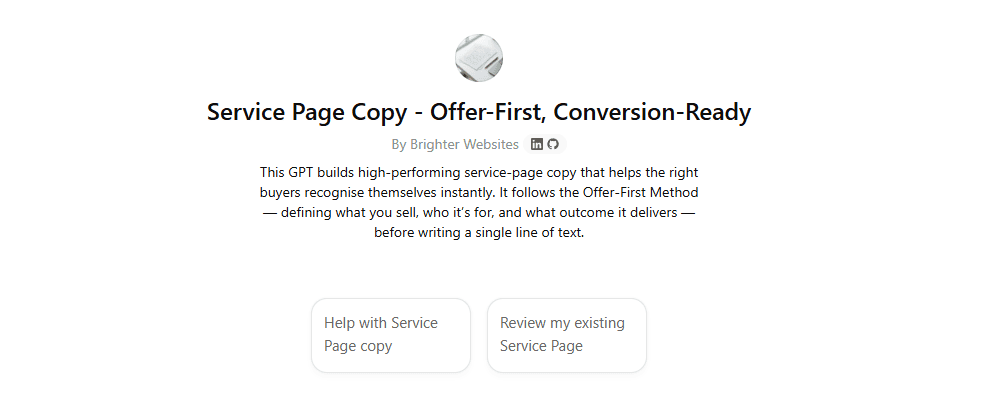
Use the “Service Page Copy, Offer-First, Conversion-Ready GPT
Most service pages explain what a business does. High-performing pages help the right buyer self-select before they ever call.
That’s the shift from traffic to revenue.
If you’d rather skip the manual process, Use the Service Page Copy, Offer-First, Conversion-Ready GPT By Brighter Websites to generate professional copy in around 10 minutes.
- Upload initial or draft service page copy
- company details (Name, Location, Email, Phone).
- Service Information and offer pathways
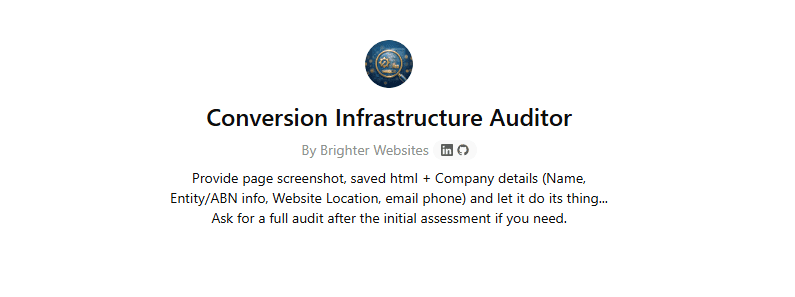
Then run your published service page through our Conversion Infrastructure Auditor by Brighter Websites for structure, authority, and UX checks.
- Upload your full page screenshot,
- Add saved HTML
- Company details (Name, ABN, Location, Email, Phone).
Ready for a High-Converting Service Page?
Your next website enquiry shouldn’t be a surprise, it should be a result of great copy, and proven design.
Request a Full Service Page Audit, Rewrite & Conversion Design, perfect if you’re ready to turn your service page into a true sales asset. You’ll get:
- A full conversion audit
- Offer first positioning and copy rewrite
- Site/Page structure and design recommendations
👉 Call 0412401933 or Ask Vanessa for a Brighter Websites CRO review of your service pages
Subscribe to our blog
Occasional emails from Vanessa about AI, SEO, Website Marketing for regional service businesses.