The Four Dimensions That Drive Authority Content Strategy
The Four Dimensions That Drive Authority Content Strategy
The strategic architecture: Known-For Position, Authority Clusters, Topic Taxonomy, and Commercial Pathways and how their relationships form at content time, not strategy time
Content-level meta emerges from the framework applied. it’s an output, not an input
The four dimensions are strategy-level lenses. Not a content writing checklist
They’re the buckets you return to when reviewing, auditing, and evolving strategy
Relationships between dimensions form at content writing time, not strategy time
The Framework Is Not Flat
Most content frameworks are linear. Research keywords, group them into topics, assign to a calendar, write content, repeat. The strategy and the execution happen in the same motion, (often at the page level) which means every piece of content requires re-doing the strategic thinking from scratch.
This framework is dimensional. There are four strategic layers. Established once at strategy phase, then applied consistently at content writing time. The connections between them form naturally as content is written. The strategic meta assigns itself because the upstream thinking is already done.
These four dimensions are also the lenses you return to when reviewing, auditing, and improving your strategy over time.
Not a checklist. A framework for assessment. Built practically for human execution and agentic workflow.
Dimension 1. The Known-For Position
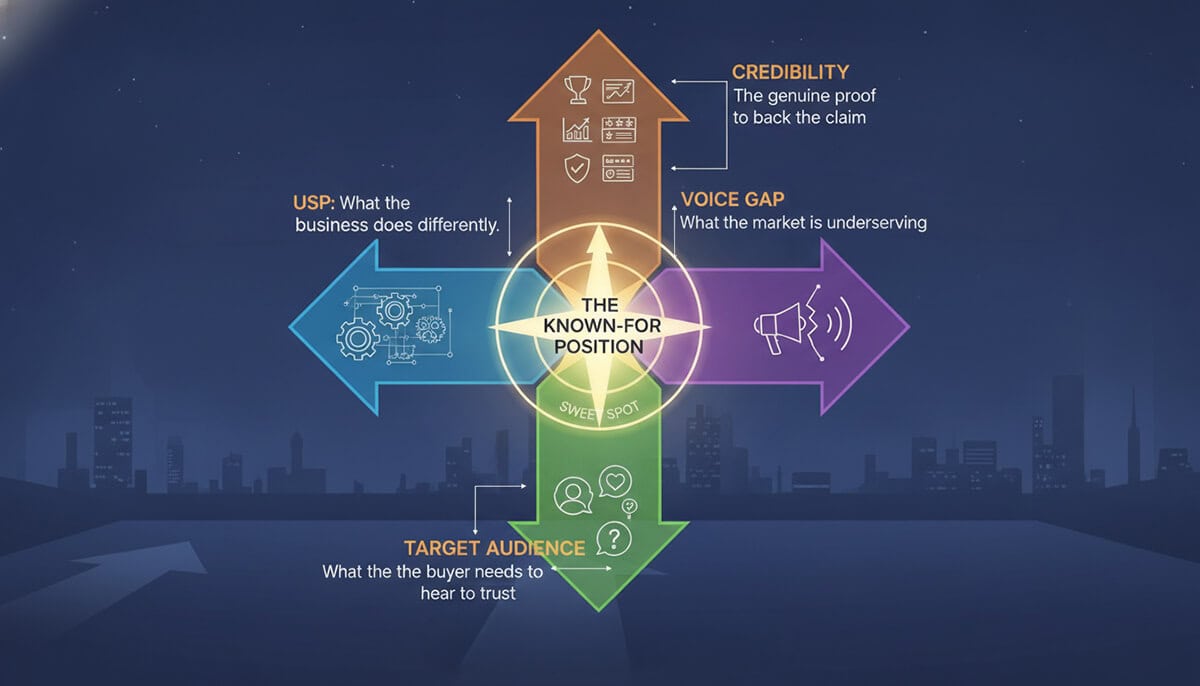
The Known-For Position is the single, defensible authority statement the business is building toward. Everything beneath it is filtered through it.
It’s not a tagline. Not a niche. Not a keyword. It’s the answer to one question: what do you want to be genuinely recognised as the authority on, in a way competitors can’t easily replicate?
It’s derived from the intersection of four things:
What the business does and how it does it differently (USP)
What the market is underserving or ignoring (voice gap)
What the business has genuine proof and experience to back (credibility)
What the target audience needs to hear to trust the business enough to act (ICA)
The Known-For Position is established first. Before clusters are chosen, before topics are mapped, before a single piece of content is briefed. Every decision is tested against it. Does this reinforce the position, or dilute it?
This isn’t a contrarian SEO position. Industry leaders are converging on the same conclusion. Neil Patel stated in March 2026 that the brands winning in AI search aren’t those with the best tactics — they’re the ones building authority AI systems recognise and trust. Exposure Ninja’s CEO puts it plainly: the future of SEO is building clear, authoritative brands that Google and AI systems cite. StudioHawk founder Harry Sanders makes the cost of unclear positioning concrete: “If people keep asking you for things you don’t sell, your positioning is just unclear. And now that AI is reading your content every day, that problem’s getting amplified.”
What this framework adds is the rigour applied to how that position is derived and tested before anything is built beneath it. Knowing what you want to be known for is the starting point of the entire strategy. Not an afterthought addressed at content writing time.
Dimension 2. Authority Clusters
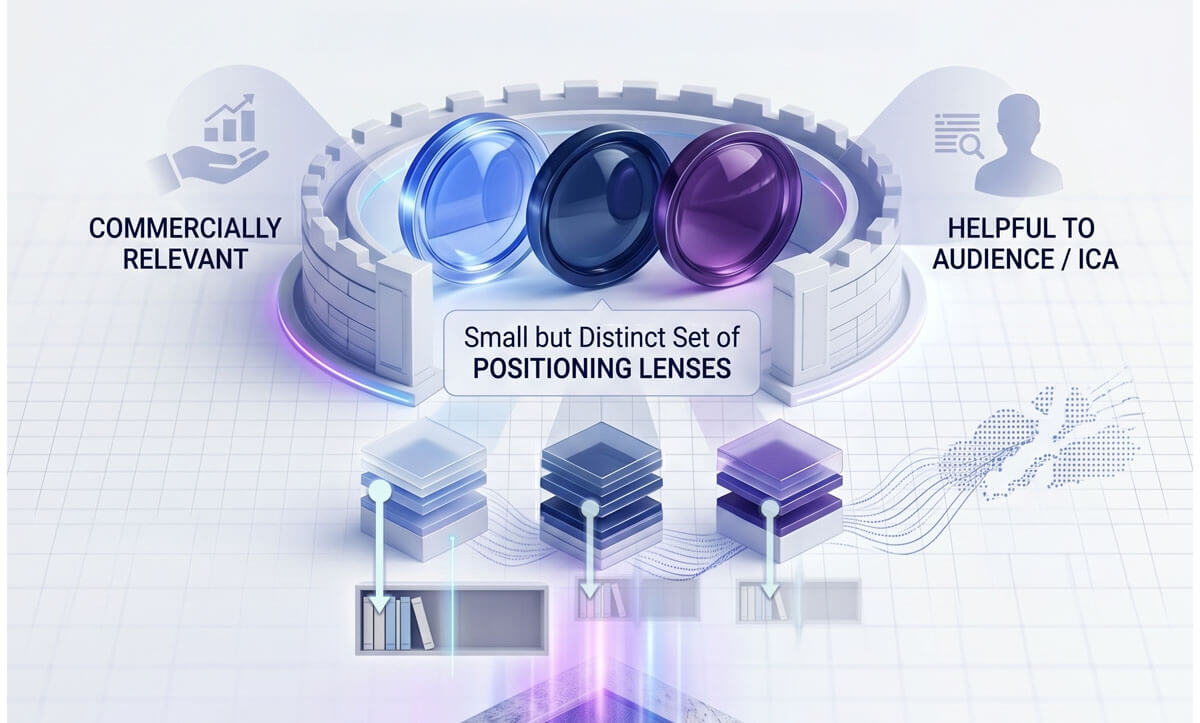
Authority Clusters are sub-components of the Known-For Position. Specific angles or lenses through which the business discusses its knowledge domains. (they are not containers or groups of topics or search queries)
A business typically operates one to three clusters. Not because more isn’t possible, but because a tighter focus compounds topical depth and authority faster than breadth. Each cluster represents a distinct positioning angle that supports the overall Known-For Position from a different direction.
The same topic can appear across multiple clusters. What changes is the angle, the audience, the framing. The cluster defines how a topic is approached.
This is the one of the key distinctions that separates this framework from standard SEO content writing models. Clusters here are strategic positioning lenses. They don’t map to topics at strategy phase. That relationship forms later (and happens organically).
Dimension 3. The Topic Taxonomy
The topic taxonomy is like the library system of “knowledge domains” the business genuinely owns.
Strict and discrete.
Each topic narrow enough to be a distinct knowledge domain, broad enough to contain multiple content angles. Generated from what the business actually knows and does. Not from keyword tools, not from competitor content audits.
Topics are stable. When an algorithm updates, Search signals change what content surfaces, when AI systems change how they retrieve content – The topic taxonomy doesn’t change. It reflects the business’s genuine expertise, which doesn’t shift because Google did.
A topic is not an article title. Not a keyword phrase. Not a content idea. It’s a knowledge domain. the subject a librarian would shelve separately, that Wikipedia would give its own entry.
At strategy phase, the taxonomy is established. Topics don’t get assigned to clusters yet. That happens at content writing time.
Dimension 4 — Commercial Pathways
Every piece of content connects to a commercial endpoint. This is non-negotiable in the framework.
Commercial pathways define the offer ecosystem. The products, services, or conversion points the business is moving people toward. Content is mapped to the pathway it supports before it’s written. Not as a CTA afterthought. As a strategic decision.
The gap this dimension fills
Most content strategy approaches address conversion late. If at all. CRO addresses it at page level: button placement, copy, UX flow. Conversion design addresses it at site structure level: how pages connect and where users go next.
What’s consistently missing is conversion thinking at strategy level. Before a single page is designed or a single article is briefed.
Reading Alex Hormozi’s $100M Offers made that gap impossible to unsee. His core insight: that offers should be framed around buyer outcomes and problems, not product catalogues. This revealed something content strategy almost never asks: does the commercial architecture underneath this content actually make sense for how people buy?
This dimension exists to answer that question before writing begins.
How it works in practice
Commercial pathways are defined by the business’s own offer structure. There’s no universal template. What matters is that the meta data structure reflects how buyers actually move through a decision.
From problem awareness to solution consideration to commitment. That content is then mapped to support that movement at each stage. We track the actual commerical end point and the content intent.
Hormozi’s value ladder concept. Entry offer, core offer, premium offer, retention and upsell is a useful as a starting frame. But the principle applies regardless of the specific model: every piece of content should be traceable to a commercial outcome, and that traceability should be established at strategy phase, not retrofitted at publishing time.
No orphaned content. If a piece of content can’t be connected to a commercial pathway before it’s written, that’s a signal worth examining before resources are spent on it.
Where the Dimensions Connect
The four dimensions are known at strategy phase. But their relationships , “the specific connections between a topic, a cluster, a service pathway, and a piece of content” form at content writing time.
The sequence at content level:
Search Intent Goal: the single short question this piece of content answers. What is someone actually asking when they need this?
Topic: which knowledge domain from the taxonomy does this draw from?
Cluster: which positioning lens is being applied? How is this topic being approached for this specific piece?
CommercialPathway: which commercial endpoint does this content support?
At this point the topic has a cluster relationship. The cluster has a topic it’s addressing. The content has a commercial purpose. And the strategy meta, intent type, content purpose, maturity level, assigns itself naturally from those decisions.
The map is built outward from the content. Not imposed on the content from above.
Dimension in the strategic content architecture.
The four dimensions are strategic architecture. Established once at strategy phase, assessed periodically, evolved as the business grows and the content base matures.
They’re not a content writing checklist. Not something to run through at article level like a form to fill in.
The operational meta recorded at content level (Search Intent Goal, intent type, content purpose, maturity marker, commercial pathway) is a separate layer. Those values emerge from the framework being applied consistently. Over time they feed back up, giving you the data to assess each dimension and make better strategic decisions.
That feedback loop is what makes the framework compound. Not just the content. The strategic clarity that improves with every piece written. The architecture is precise enough for agentic execution and AI visibility from day one.