

I Thought I Didn’t Come From a Business Family. I Was Wrong.
I thought I didn’t come from a business family. Turns…


In 2025, Google and AI rank trust, not tricks.
To send the right signals, make your business machine-verifiable:
keep NAP identical everywhere, use schema markup, build real local proof, fix technical speed, and show visible expertise.
That’s what makes AI engines cite you, and why SEO now starts with clarity, not keywords.
SEO isn’t about gaming algorithms anymore. It’s about building systems Google and AI engines can trust.
In 2025, the strongest signals come from businesses that combine local trust + technical clarity + visible proof. That mix decides whether your brand gets cited by A or vanishes beneath it.
I’ve seen this in dozens of audits, when your name, address, or phone number doesn’t match, AI models treat you like three different businesses. Google’s systems crave precision.
Do this:
When those match, Google reads you as a single verified entity. That’s your digital source of truth, and the first step toward machine-verifiable credibility.
Want to show up for “landscaper in Geelong” or “electrician Ballarat”? You still need to prove genuine local presence, but not by pumping out cookie-cutter suburb pages.
Here’s the smarter approach:
Turn your real-world projects into customer success stories that naturally mention local places and suburbs, names of clients and the services delivered. Each story becomes a mini-case study, a piece of proof Google and AI can trust.
What to include:
This format delivers something “location pages” never can: experience, expertise, and authenticity.
Vanessa puts it simply: “location pages risk thin, repetitive content that adds no real value”.
Case-study storytelling proves you’ve done the work, in the community, for real clients.
Google and AI don’t just want to see where you operate, they want evidence you’re trusted there.
Show them through lived results, not templated suburb pages.
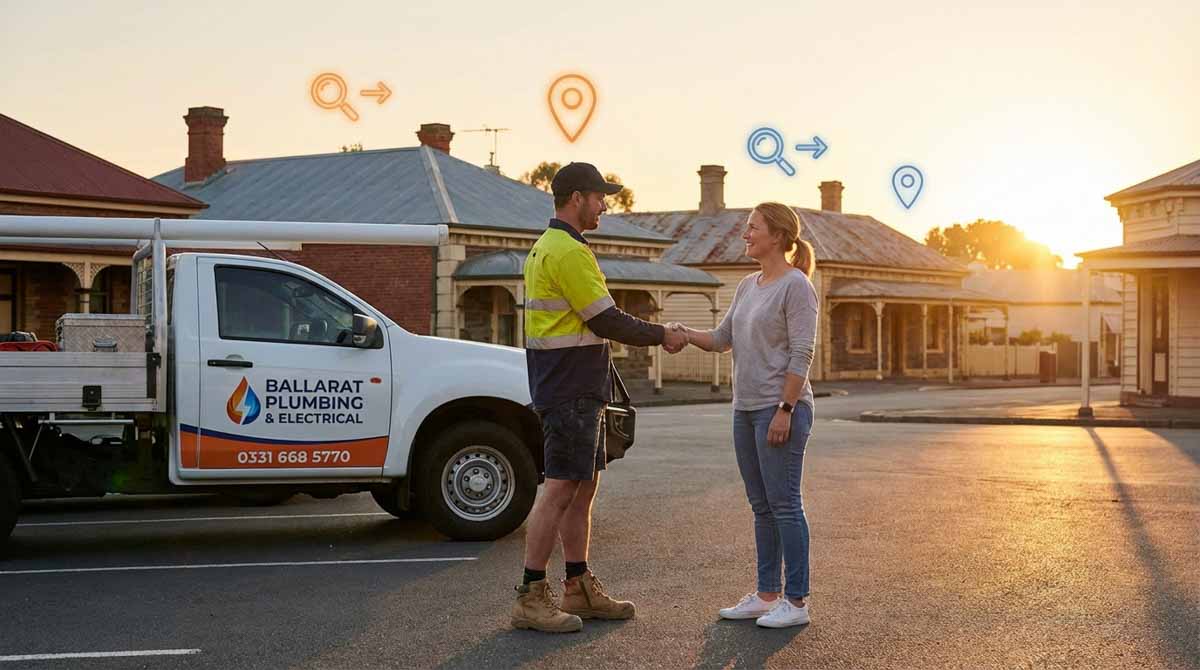
Your GBP is Google’s homepage for your business. It shows up when people search for your brand name, and in the map pack once your website and GBP are strong and in sync.
Example: a Ballarat service client doubled Map-Pack visibility in six weeks just by posting weekly project updates and review replies. That’s our a “Authority Anchor #5” in action, community proof feeding rank trust. Learn more about Dominating the map pack for Businesses in regional areas.
Backlinks still matter, but 2025 rules changed: Local businesses need Quality backlinks from local sources.
Here’s some smart ways to earn them:
Even five community backlinks outperform a hundred generic ones. That’s how AI learns who the locals trust.
Over half of local searches end on phones. And voice assistants read your answers aloud now.
Mobile non-negotiables:
UX is a ranking signal disguised as a user test. Fail it and you disappear.
Generative Engine Optimization (GEO) is where SEO meets AI. Google’s SGE, Perplexity, ChatGPT, they pull structured, quotable text.
Make your content AI-readable:
When your site’s content is “extractable”, AI engines cite you by name, the new form of “ranking #1.”

We’ve rebuilt sites that looked great but died in Google’s crawl. No amount of content fixes a broken infrastructure.
Quick technical audit:
When we rebuilt Guerrilla Steel’s site, load time dropped below one second and visibility rose during the September 2025 algorithm update, while 77 % of competitors lost traffic. That’s algorithm resilience through technical excellence.
AI systems cross-check claims with visible proof. Make yours easy to find and structured to verify. E-E-A-T is how Google decides who to believe.
Show it:
Learn more about our Authority Lead Topic Cluster Framework and exactly how to find, and add E-E-A-T elements on each page.

Getting found is step one. Turning that visibility into booked jobs is the real win.
We’ve learned this in regional builds. When a business hits the Map Pack but the site can’t convert, slow load, confusing CTAs, no trust hierarchy, traffic just bounces. That’s where conversion infrastructure takes over.
Every Future-Proof Growth Website we build follows that chain: AI-ready structure → clear conversion pathway → trackable ROI. When Guerrilla Steel’s visibility jumped 80 % in 28 days, their enquiries rose 42% because the form, proof panels, and CTA flow were engineered for conversion.
Visibility without conversion is noise. Together, they create a growth system.
So before chasing the next ranking, ask: If someone lands on my page today, can they trust me enough to click “Book Now”? If not, the fix isn’t more SEO, it’s better conversion architecture.
That’s why our Future-Proof Growth Website framework builds both, AI-ready visibility signals and the conversion systems that turn those signals into revenue.
SEO in 2025 isn’t about chasing rankings, it’s about clarity and trust that machines can understand. Fix the infrastructure, show real-world proof, and visibility follows naturally
If you’re not sure whether your site’s sending the right signals, start with an AI SEO Deep Dive Audit. You’ll see exactly which signals to strengthen, how your pages convert, and where compounding growth starts.

Discover more expert insights to the latest Web Design and SEO trends, these curated blog posts are designed to broaden your horizons and spark your imagination.





Hit submit and I’ll reach out by email or phone to help you get started. Your details stay private, see the Privacy Policy.
Hit submit and I’ll reach out by email or phone to help you get started. Your details stay private, see the Privacy Policy.
A WordPress Commenter says:
Hi, this is a comment.
To get started with moderating, editing, and deleting comments, please visit the Comments screen in the dashboard.
Commenter avatars come from Gravatar.