To make AI-generated writing feel more human, remove the punctuation habits that give it away - and em dashes are one of the big ones. A cleanup tool can help, but the real fix is better rhythm, better sentence variation, and less formulaic phrasing overall.
Table Of Contents
UPDATE 16/02/2026: This framework has evolved based on implementation and real-world results. Read the updated ALTC framework here:
This article remains as a record of the original thinking and has been canonicalized to the new version.
21/12/2025 Update: Since publishing this article, I’ve continued developing the ALTC Framework, refining how Authority Anchors and Proof Libraries connect into practical website structures. A Version 2.0 update is currently in development, expanding on authority architecture, proof integration, and commercial maturity mapping.
Ninety days ago, Google started dropping my agency’s web pages like hot potatoes. Half of my articles weren’t even indexed anymore. After the latest core update, my site had officially tanked. Here’s the truth: I never built my own site with the same SEO discipline I give my clients. My clients always came first, so my own site never got the attention it deserved. I never gave SEO the property attention. Until now.
Back to Basics
I did what I always tell my clients to do: I went back to basics. I mapped out my business goals, revisited my customer personas, reviewed competitors, and redefined my marketing objectives.
When it came to strategy, I faced a choice:
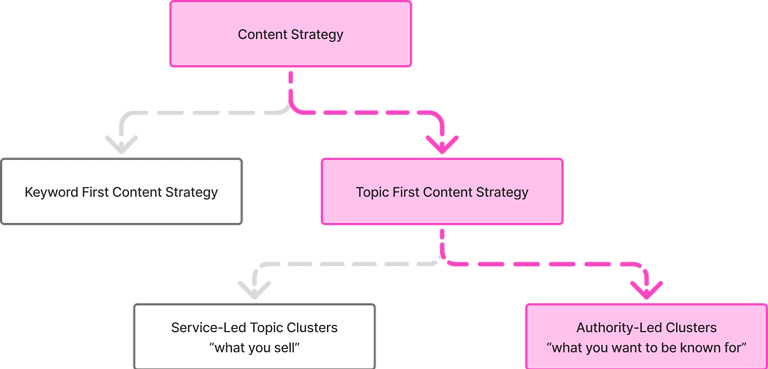
Build a keyword-first plan (classic clusters driven by search demand), or
Build a topic-first plan (clusters shaped around core services and themes).
I chose the latter.
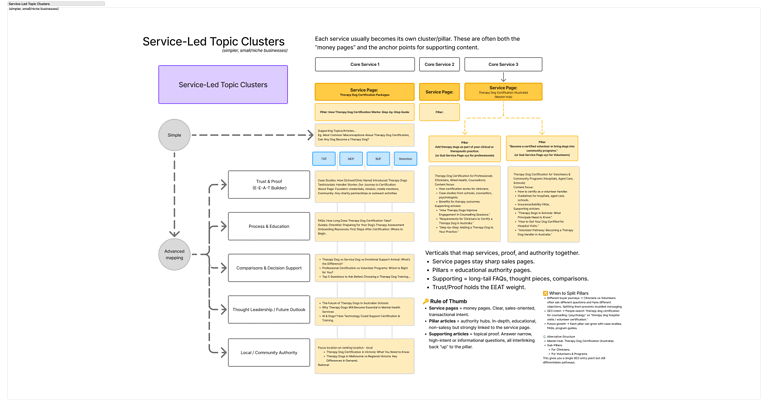
For local, service-based businesses, topic-first clusters are usually the right choice. Each service becomes its own “mini-site”:
Money page → the core service page.
Pillars → detailed authority pages that explain, educate, and add depth.
Supporting content → FAQs, comparisons, thought pieces.
Proof → case studies, testimonials, credentials, community involvement.
I’ve used this model for clients tradies, dog trainers, bookkeepers and it works beautifully. It keeps things sharp and simple. Each service page is the sales anchor, and the supporting content proves expertise.
So naturally, I thought: if it works for my clients, it will work for me.
This structure is simple, scalable, and highly effective where competition is light.
It’s why my local clients succeed with it, each service gets its own vertical, a cluster of similar or related topics with enough proof and depth to dominate their niche.
Take Guerilla Steel, for example. We launched their brand-new website in February 2025. By August, the owner came to me looking for more exposure. I applied my Website First Marketing Blueprint and focused tightly on one main service: horse stable kits.
Within 90 days, Guerilla Steel was:
Owning 80% of the AI Search brand voice for horse stable kits.
Averaging >9 positions sitewide in organic search.
Growing so visibly that even big industry names started bidding on their brand name in PPC just to compete.
That’s the power of service-led clusters: one core service, supported by proof and depth, can dominate a niche market fast.
But here’s the catch. While this model worked brilliantly for Guerilla Steel and for other local clients like tradies, therapists, and bookkeepers, I knew it would not work for me.
In SEO and web design, vertical service-led clusters are not enough. Every possible “how-to” and “explainer” already exists 100,000 times over. Publishing more of the same doesn’t build authority, and without authority, you’re invisible.
There had to be another way…
I needed to go deeper – beyond just mapping services into clusters. Topic-first wasn’t wrong. But it wasn’t enough either. What I really needed was the other branch of topic-first: Authority-Led Topic Clusters.
Why? Because AI systems reward thematic authority, not isolated posts.
Google’s AI Overviews and emerging knowledge engines don’t care if you wrote one “perfect” service page.
They’re looking for patterns – depth across services, education, proof, comparisons, and thought leadership.
Authority isn’t built in silos; it’s built across a web of interlinked, evidence-rich content that proves you know your subject inside-out.
That’s the difference:
Service-Led Clusters → map 1:1 to what you sell.
Authority-Led Clusters → map to what you want to be known for.
But that raised the bigger question: how do we actually plan for authority?
Content Strategy Decision Tree
Model
Service-Led Topic Clusters
Authority-Led Topic Clusters
Core Idea
About what you sell
About what you want to be known for
Structure
Each service = its own cluster (money page + supporting FAQs, proof, case studies)
Expansive clusters radiating out into themes (branding, CRO, AI SEO, comparisons, thought leadership, trust/EEAT)
High-competition industries (e.g. SEO, Web Design, Finance, Law, Health)
Goal
Direct, transactional, efficient. Sharp sales pages backed by just enough proof.
Expansive, educational, proof-driven. Builds trust and visibility at scale.
Strength
Simple to execute, fast wins, dominates local/niche searches
Creates thematic authority rewarded by Google & AI search engines
Risk
Too shallow for competitive industries → you drown in noise
Requires more resources, planning, and sustained effort
Rule of Thumb
Works when you don’t need sprawling content to rank
Essential when markets are crowded and “everyone has a how-to”
How to Plan for Authority
At first, I started to wonder – wait a second, isn’t this the same thing? Aren’t service-led clusters and authority-led clusters just the same wheel spun two ways?
On the surface, yes. Both revolve around a primary service. Both involve pillars, supporting content, and proof. Diagrammed side by side, they almost look identical.
The key difference is intent.
Service-led clusters are generally linear. They flow directly: Service → Supporting Proof. The goal is to rank and convert for one clear service.
Authority-led clusters are multi-dimensional. They spread wider: Topic → Service + Education + Thought Leadership + Proof. It’s important to own the theme and build authority across the whole cluster topic, not just a money page.
In practice:
Service-led = “Rank and convert for my exact service.”
Authority-led = “Build authority in an entire thematic area, so my service page ranks as part of a bigger footprint.”
Why this matters
For clients like Paws for Support or Guerilla Steel, service-led works beautifully. They’re in low-competition niches where search demand is narrow and clear. Each service can map directly to its own cluster and dominate.
But for me working in SEO and web design, service-led wasn’t enough. In competitive spaces, you need to prove depth across an entire theme. That’s the only way to signal authority to both Google and AI-driven overviews.
Authority-Led Topic Clusters in Practice
Planning for authority means thinking beyond single services. Instead, you layer multiple types of content around your theme:
Service pillar → your offer, clearly defined.
Proof pillar → case studies, testimonials, results. Multiple types of proof
Comparison pillar → side-by-sides, “X vs Y,” cost breakdowns. that help decision-making.
Thought leadership pillar → forward-looking insights, trends, original frameworks that pushes the industry forward.
Results-in-advance pillar → free tools, downloads, audits that show real expertise.
Local authority pillar → community presence, regional trust signals.
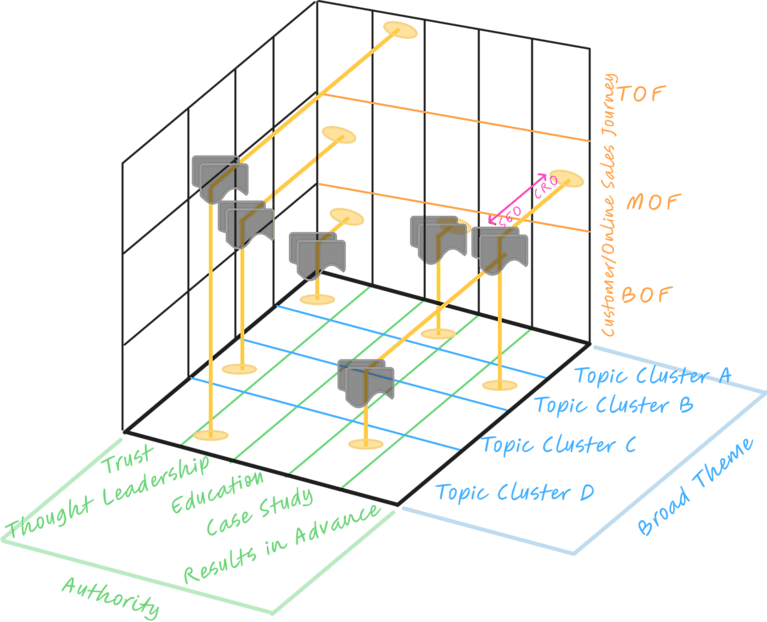
Each piece is valuable on its own. But together, they form a cube of authority:
What you want to be known for.
How you prove it.
Where it fits in the buyer journey.
This is what AI and Google reward in 2025 not thin service pages, but layered, interlinked ecosystems of authority.
Why This Matters for the AI Search Era
This structure means:
You’re more likely to be cited in AI overviews.
You build trust faster with human visitors.
Your services are framed as part of a bigger expertise narrative.
Authority-Led Topic Clusters are how you future-proof your content strategy in the AI search era.
But What About Keywords?
I can already hear my fellow SEOs: “But you haven’t even talked about keywords yet!”
And honestly, this is the best part.
Instead of asking “What keywords should I target?”, the better question is:
“What do I want to be known for, and how can I prove it across every authority pillar?”
if AI and Google are rewarding authority signals over isolated keywords, then maybe keywords aren’t where you start anymore. They’re just how you polish the work you’ve already mapped out. This flips the SEO script on KW research:
The Old Way (Keyword-First SEO)
Keyword Research → start with tools, find high-volume terms.
Cluster Around Keywords → group phrases into content hubs.
More Keyword Research → refine, chase gaps.
Write Content → based on keyword sets.
Optimise for Keywords → headline tweaks, density checks, meta tags.
Result: You end up with content that matches keywords but doesn’t always build authority. volume decides value. keywords then content, content builds authority.
The New Way (Authority-First / Brighter Websites: Website First Blueprint)
Start with Services & Offers → what you actually sell, your USP.
Map the Service Funnel → awareness → consideration → decision → retention.
Distribute, Track & Improve → publish content across channels, track performance, optimise for conversion
Result: Authority decides value. Clusters are defined by authority; keywords refine the content. You end up with authority-led topic clusters that strengthen both Traditional and AI Search visibility, while feeding your funnel and still capturing demand.
I haven’t fully implemented this framework yet but my prediction is that this could be the way forward, high competition or not.
Why Keyword-First Feels Pointless in Saturated Niches
In heavily saturated niches like SEO and web design, traditional keyword research at the start just feels futile.. You can’t research your way out of a market that’s already saturated. Every phrase, every angle, every “best practice” keyword has already been fought over for years. Starting with keyword research first in a mature niche like SEO or web design is like trying to buy vacant land in a city. At best, you’re paying top dollar for a tiny block squeezed between skyscrapers and you’ll spend years wrangling permits before you can even break ground.
Instead of chasing scraps of land, authority-led clusters are about building a landmark tower that reshapes the skyline.
And if you think about how search is changing, I might actually have a point.
AI-driven results and even Google’s traditional SERPs don’t care if you matched a keyword. They care if you’ve built authority.
What they’re really looking for is thematic coverage proof that you’ve mapped the whole landscape, not just staked a flag on one block.
It’s not about stuffing a phrase into a headline. It’s about showing depth, breadth, and expertise across every angle of a topic:
the service itself,
the education around it,
the comparisons and context,
the proof that you deliver,
and the thought leadership that moves the industry forward.
That’s what earns trust, with Google, with AI, and with your audience.
How I See Authority Planning Working
When you structure your site this way, you don’t just rank you own the conversation.
Retention (onboarding, thank you pages, follow-ups).
3 Lay your foundations.
Every site needs structural assets: About page, quote page, blog/portfolio archives, thank-you redirects, booking flows. These aren’t just filler, they’re authority anchors.
4 Identify authority pillars.
For each service, map out what “proof” you need (case studies, testimonials), what “education” you’ll provide (guides, FAQs), what comparisons will help buyers decide, and what thought leadership sets you apart.
Extract topics naturally.
From those assets, themes emerge. Instead of starting with keywords, you start with what matters to your service and buyer journey. These themes start to form the skeleton of your Authority led Topic cluster plan.
Layer in Core USP / “Known For” Themes.
Core USP / “Known For” Themes are the anchor points of your Authority led Topic clusters. They answer: What do you want to be known for in the market? USP + Themes/Topics from the previous step help define your Broad theme(s) and the specific Topic Cluster.
Validate with Keywords (but don’t be ruled by them)
Only now do you checks Now’s the time to check search demand, but treat keyword research as validation, not the foundation.
Yes, there’s demand? Great. Build it into your clusters, prioritise it, and map it to the funnel.
No obvious demand? That doesn’t mean drop it. If the content strengthens your authority pillars, supports your USP, or fills a funnel gap, it still earns a place.
Because here’s the shift:
For traditional SEO, low search volume means low value.
In authority-led SEO, even “zero-volume” keywords can carry high authority: AI systems look for depth, completeness, and topical coverage.
Search tools measure demand. Authority comes from depth and trust.
Plan Site Structure
Skeleton → Navigation, categories, URL depth.
(Content Structure = Brain → Content organisation by themes/clusters mapped to buyer intent.)
Prioritise & Build Content Calendar
Which clusters move the needle fastest?
Which ones are foundational for authority?
Write and optimise per page.
Now you can do targeted KW research at the page/article level.
This is where tools like Surfer or NeuronWriter shine, fine-tuning, not blueprinting As you draft, optimise on a page-by-page basis with tools like SurferSEO or NeuronWriter. At this stage, keywords refine the work, not define it.
Distribute, track, improve.
Authority isn’t built by hitting “publish.” You distribute across channels, track performance, and improve over time. This closes the loop in my Website First Blueprint.
Update Marketing Channel & Funnel Activities
Every authority cluster you plan will spark ideas for supporting content, things like:
Lead magnets (checklists, guides, calculators).
Article series that walk a buyer through a process.
Case studies or proof assets that reinforce trust.
These aren’t “extras.” They’re part of your funnel, and they need to be tracked.
Connect them to your Website First marketing plan. This will help you remember to do them by adding them to your to-do list, content calendar, or campaign planner.
In this way, your authority groups don’t just stay as blog posts. They keep your funnel full by handling leads, helping with sales, and making sure that your positioning is strong across all of your marketing channels.
Want to See How This Works in Practice?
I’m documenting the process live in FigJam. The Authority-Led Clusters framework isn’t just theory, I’m mapping it out in the real world.
The flow goes: SEO Health Audit → establish the baseline. Keyword-first vs Topic-first → where most strategies stall. Authority Pillars & Cluster Mapping → the new model that builds depth and trust.
And because I believe your website should sit at the centre of everything, I’m also mapping my Website-First Marketing Blueprint, from documenting your products/services, competitors and personas through to generating objectives, kpi’s, initiatives and activities with the web site as the heart of the channel mix.
If you’re an SEO, marketer, or industry leader, I’d love to collaborate – Drop me an email support@brighterwebsites.com.au or call me +61412401933 . Do you see gaps? Overlaps? Better ways to refine the model? This is still evolving, and your insights could help shape what authority-first SEO looks like in the AI search era
Subscribe to our blog or get in touch.
Get in touch with with Vanessa. Your Ballarat website strategist, designer and developer.
Occasional emails from Vanessa at Brighter Websites about AI, SEO, Website Marketing for regional service businesses.
See what we have done
More Articles
Discover more expert insights to the latest Web Design and SEO trends, these curated blog posts are designed to broaden your horizons and spark your imagination.