

Authority Clusters
Clusters as positioning lenses, not topic containers. Understand selection criteria, what makes a cluster defensible, and why the topic-cluster relationship forms at content writing time rather than strategy time.
Summary
An Authority Cluster is a strategic positioning lens. The specific angle through which a business approaches its knowledge domains in content. Clusters are sub-components of the Known-For Position, not containers for topics. The same topic addressed through different cluster lenses produces different content, different authority signals, and different audience positioning. That angle, applied consistently over time at depth across topics (and eventually in off-site brand mentions too) is what makes expertise recognisable and distinct.
Table Of Contents
Definition
An Authority Cluster is a strategic content theme. It’s a positioning lens that defines how a business approaches a set of related knowledge domains and why that approach is distinctive and commercially relevant.
A cluster does not contain topics. It does not group articles. It does not map to a section of a website or a category in a content plan. It is the angle of approach. The consistent framing that shapes how knowledge is expressed across content, over time, at depth.
The same topic addressed through two different cluster lenses produces two structurally different pieces of content. The knowledge domain is the same. But the positioning change forces the topic and Search Intent Goal to produce a unique authority signal
- with distinct framing,
- a different search intent goal,
- a different audience,
- a different commercial endpoint, and
- a different expression of the same expertise.
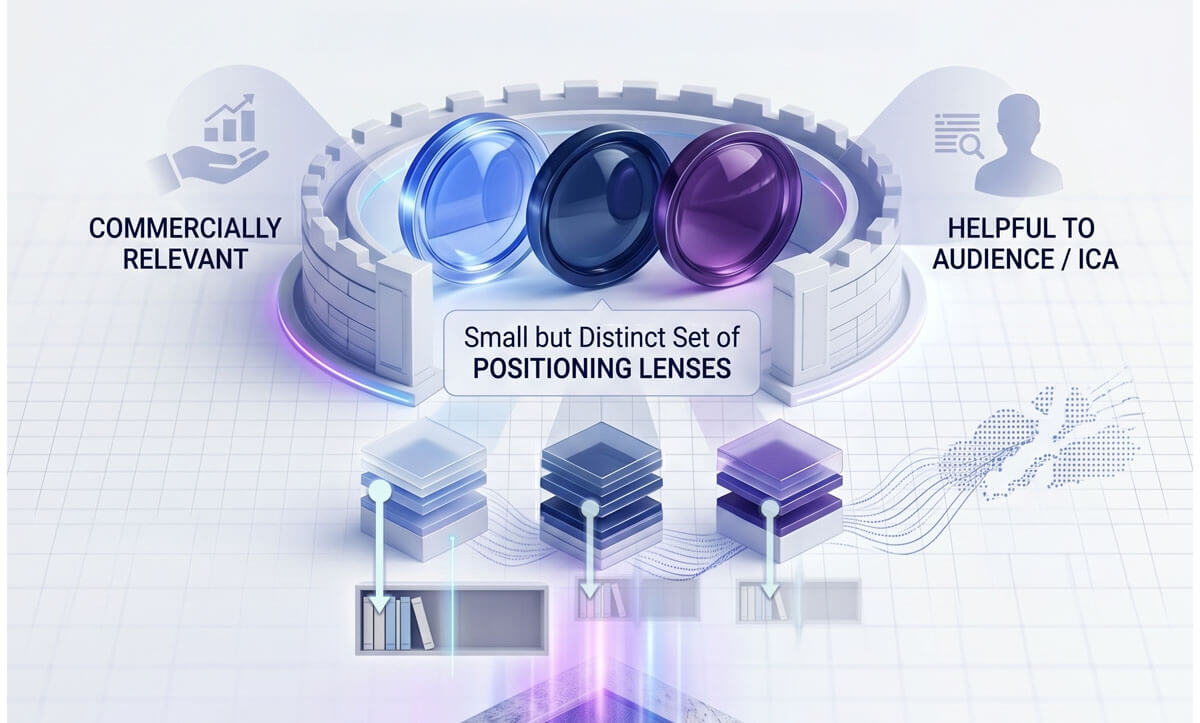
Clusters as Sub-Components of the Known-For Position
Authority Clusters are sub-components of the Known-For Position. Each cluster distinctly supports the Known-For Position from a specific direction, a second-level breakdown of what the business is building toward.
A useful way to see this: each cluster could almost, in isolation, function as a Known-For Position for a narrower or more specialist business.
A landscape architect whose Known-For Position is “heritage-sensitive site transformation for Victorian residential properties” might operate three clusters: “Art led ecological restoration”, “cultural heritage interpretation” and “client collaborative design”.
Each could be a defensible authority position in its own right. But at the cluster level they act as the specific lenses through which the broader Known-For Position is expressed in content.
The distinction between a Known-For Position and an Authority Cluster is not about scope alone. The Known-For Position defines what the business is recognised as the authority on. The cluster defines how that authority is expressed in content, “the angle” or perspective applied to knowledge domains in content.
It is the HOW, not the WHAT. And that HOW, applied consistently over time at depth across topics, and eventually in off-site brand mentions too, is what makes expertise recognisable and distinct.
What Makes a Cluster Valid
A cluster becomes well defined by five properties.
All five must be established before content is assigned to it.
- Positioning Goal The specific authority position this cluster builds toward, in direct support of the Known-For Position. A cluster without a clear positioning goal is a content category, not a strategic lens.
- Voice Gap The specific gap in the market, in content, perspective, depth, or framing, that this cluster fills. The voice gap is what makes the cluster defensible: it describes not just what the business covers but the angle competitors are not taking. When a cluster repeats the market narrative, it struggles to differentiate. When it introduces a distinct narrative, it becomes memorable.
- Commercial Purpose The service pathway(s) this cluster supports and the commercial outcome it drives. Every cluster must connect to at least one commercial endpoint. A cluster that cannot be traced to a service or offer is an editorial project, not a strategic one.
- Audience Who the cluster speaks to, across both the visitor journey on the websites and the customer lifetime journey. The same business may serve different audiences through different clusters. The audience definition shapes tone, and the type of proof that will resonate.
- Maturity Goal The authority maturity level this cluster is building toward. It is the credibility standard it is held to. Writing consistently below actual expertise level produces no credibility gain, regardless of how unique or well-written the content is. Surface-level entry content written by a genuine expert is still surface-level. The maturity goal is what ensures the depth of expression matches the depth of knowledge. Its what makes the cluster a credibility signal over time, not just a content volume signal.
How Clusters Are Selected
Clusters are derived downward from the Known-For Position, not upward from topic coverage or content volume.
The selection question is: what are the distinct angles through which this business can express its Known-For Position in a way that is defensible, commercially grounded, and fills a genuine market gap?
A business typically operates one to three clusters. A tighter focus build topical depth and authority faster than breadth. Each cluster requires sustained content investment over time to build genuine authority. Spreading that investment across too many perspectives produces shallow coverage in all of them.
The “complexity filter” applies here. Low competition markets with straightforward positioning may need only one cluster, or a simpler Cluster that mirrors their services (a service led cluster) approach rather than full Authority Cluster development. High saturation markets where differentiation is the primary challenge benefit from the precision of two to three well-defined clusters, each filling a distinct voice gap.
The Assignment Logic
The relationship between a topic and a cluster does not exist at strategy level.
It exists at the page level, in the content that carries both assignments simultaneously.
At content planning stage, three things are assigned in sequence: the Search Intent Goal, the Topic, and the Cluster. At that point, a relationship is created.
The topic now has a cluster framing. The cluster now has a Primary topic it is addressing. The content has both a knowledge domain and a positioning angle.
This means:
- The same topic can appear across multiple clusters within the same business, approached differently each time
- A cluster does not define which topics belong to it, the page assignments do
- Topics are never pre-mapped to clusters in the strategy document
The map is built outward from the content. Not imposed on the content from above.

In Practice: One Business, Three Lenses
The One Team QLD strategy illustrates how three clusters operate as distinct lenses across a shared knowledge base.
- Relationship Reconnection approaches the practice’s knowledge domains through the lens of couples work, emotional distance, recurring conflict, intimacy, trust repair. The positioning angle is: patterns have mechanisms, and those mechanisms can be made visible and interrupted.
- Integrated Wellness approaches the same knowledge base through the lens of individual support, modality selection, transition between therapeutic stages, inclusive practice. The positioning angle is: the right kind of support depends on what the client needs, not what the practitioner offers.
- Entrepreneur Wellness approaches the leadership and mental health domains through the lens of founder experience, the emotional reality of running a business and how it directly affects strategic performance. The positioning angle is: the person running the business is the business, and sustainable performance requires integrated support.
The topic “Anxiety and Stress” appears across all three clusters.
- In Relationship Reconnection, it is framed through the impact on couple dynamics.
- In Integrated Wellness, through the modality best suited to address it.
- In Entrepreneur Wellness through its specific effect on founder decision-making and business/personal relationship outcomes.
Three distinct angles with the same knowledge domain. Three structurally different pieces of content, each building toward a different facet of the same Known-For Position.
The addition of Search Intent Goal to the equation provides the third dimension that significantly increases the range of content options available within each cluster. Cluster lens, topic, and Search Intent Goal working together create a structural guarantee of distinct expression. Covering more facets of a knowledge domain at depth, while limiting overlap and ensuring each piece occupies its own territory within the authority position being built.
Commonly Conflated Concepts
A topic group or content category A topic group organises content by subject matter, all articles about social media in one group, all articles about analytics in another. It is a filing system. An Authority Cluster is a positioning system.
The difference is that a topic group tells you where content lives. A cluster tells you how it is framed and why that framing builds a specific kind of authority.
A keyword cluster A keyword cluster groups search terms by semantic similarity or shared intent, phrases that likely target the same or related queries. It is a retrieval-oriented construct built from external search data.
An Authority Cluster is built from the inside out: from the business’s Known-For Position, its voice gaps, its commercial structure, and its proof capability. The two constructs operate at entirely different levels and are not interchangeable.
A content pillar A content pillar in conventional SEO usage describes a long-form anchor piece supported by a collection of related shorter pieces linking back to it. It is an architectural pattern for a set of pages. An Authority Cluster is a strategic lens applied across content, it is not a page, not intended as a descrete hub, and not defined by any particular architectural pattern. A cluster may produce pillar-style content within it. The cluster itself is not the pillar.
A service area or product category A service area defines what a business sells.
An Authority Cluster defines how the business talks about the knowledge domains that surround and support what it sells.
The two are related, every cluster must connect to a commercial pathway, but they are not the same. A business with three service lines does not automatically have three clusters. The cluster structure is derived from positioning and voice gaps, not from the service menu.
Relationship to Other Framework Components
Authority Clusters are sub-components of the Known-For Position and derive their validity from it. A cluster that cannot be connected back to the Known-For Position is pulling in a different strategic direction.
Clusters are independent of the Topic Taxonomy. Topics are not assigned to clusters at strategy stage. The relationship forms at the page level when both are assigned to the same piece of content.
Each cluster is defined in part by its Maturity Goal. The credibility standard the cluster is held to over time. Content written below that standard produces no credibility gain regardless of volume or uniqueness. The maturity goal is what ensures the cluster builds genuine authority rather than simply accumulating content.
Each cluster must connect to at least one Commercial Pathway. That connection is what prevents clusters from becoming editorial projects rather than strategic ones.