

The Known-For Position
How a defensible authority position is derived from the intersection of USP, voice gap, credibility, and target audience and how it functions as the strategic filter for every component beneath it.
Summary
The Known-For Position is the single, defensible authority statement a business is building toward. It is derived before any other strategic decision is made and functions as the filter every subsequent component is tested against.
Table Of Contents
Definition
The Known-For Position is the single, defensible statement of what a business is recognised for, or intends to become recognised for.
It defines the authority position the business seeks to own within its market and serves as the strategic anchor for content, messaging, and visibility..
It describes a specific territory of expertise that the business genuinely owns: grounded in what it does differently, what the market is underserving, what the business has credibility to back, and what the target audience needs to hear to trust it enough to act.
It is established once, at the beginning of strategy development. Every cluster, every topic, every piece of content is subsequently tested against it. Content either reinforces the position or dilutes it.
There is no neutral.
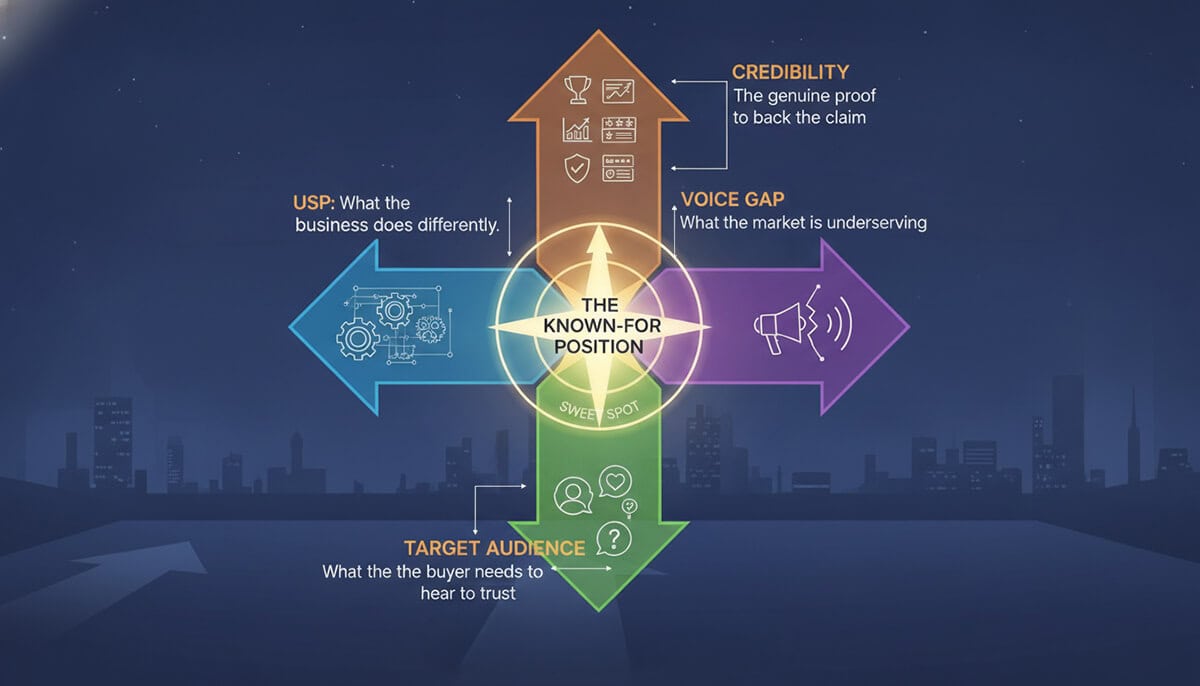
Four Inputs that construct the known for position.
The Known-For Position is derived from the intersection of four elements. Each input is necessary. A position derived from fewer than is incomplete and and not defensible.
What the business does and how it does it differently
The service or product offer, and the specific aspect of delivery, methodology, or approach that competitors do not (or can not) replicate. This is not a list of services. It is the quality or characteristic of the work or customer outcome that is genuinely distinct.
Where the market voice gap is
The specific territory. A topic, a perspective, a depth of treatment, an audience. Gaps that competitors are either silent on or covering poorly. A position built into a genuine gap compounds fast. A position built into a saturated, undifferentiated space moves slowly and rarely compounds in value.
What the business has credibility to back
The proof, experience, and track record that makes the position sustainable. A claimed authority position without the evidence to support it fails under scrutiny. It is not trusted by buyers, from search systems, and from the AI retrieval mechanisms that now mediate how expertise is recognised and cited.
What the target audience needs to hear to trust the business enough to act
The specific framing that makes the position relatable and compelling to the people the business is trying to reach.
A position can be accurate and defensible and still fail to connect if it is framed in terms the audience does not recognise. The position must be relevant to their situation so they can connect with the message easily.
The intersection of all four is where the Known-For Position lives.
It should not be the most aspiration, or loudest not the one with the greatest search volume, it sits firmly where all four are simultaneously true.
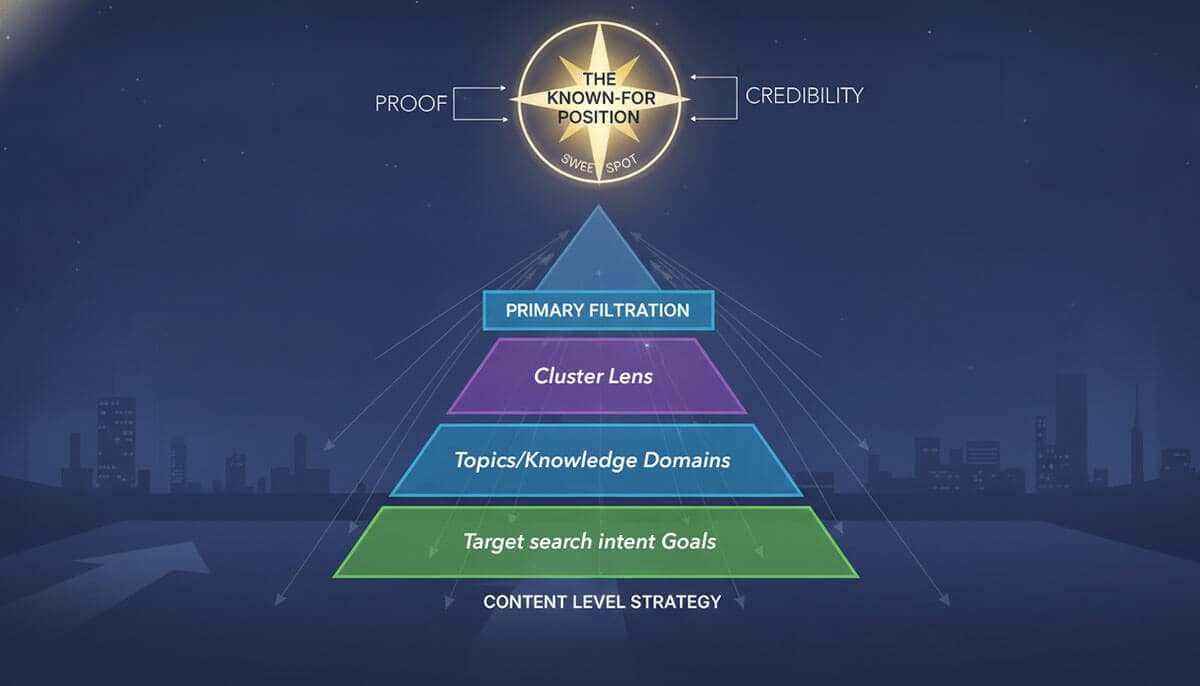
How It Functions – The North Star of the entire strategy
The Known-For Position sits at the top of the strategic architecture. It does not change when content strategy evolves, when clusters are added, or when the topic taxonomy is extended. Those things develop beneath it.
Its function is filtration. Before an Authority Cluster is selected, the question is: does this cluster build toward the Known-For Position, or does it pull in a different direction? Before a topic is added to the taxonomy, the same question applies. Before a piece of content is briefed, the same question again.
A business can rank for many things. It should be known for one position.
Breadth of ranking is a traffic outcome. The Known-For Position is an authority outcome.
The authority outcome is the specific thing the market, AI systems, and referrers associate with the business when the relevant category comes up.
In Practice: What Derivation Looks Like
Deriving the Known-For Position requires structured business intelligence.
This provides a clear picture of the offer, the competitive landscape, the available proof, and the target audience.
In the Authority Led Topic Cluster Fast Track process, the Known-For Position is identified through a 17-question intelligence extraction applied to selected business assets, competitor assets, social content, and user-generated content. This occurs before any strategic recommendations, positioning decisions, or content planning activities take place.
The output is a single statement. Typically one to two sentences. Specific enough that a competitor reading it would recognise the territory being claimed. Broad enough that it can sustain multiple clusters and years of content development beneath it.
Worked example — One Team QLD: “Springfield’s integrated counselling + coaching authority for couples with businesses, bridging emotional healing and practical forward movement in a way traditional therapy or coaching alone does not.”
This satisfies all four inputs: the differentiation is the integrated model (USP); no local competitor bridges counselling and coaching explicitly (voice gap); Jef Langford holds 22+ years of business ownership experience alongside clinical practice (credibility); and couples and founders researching support options need to understand why integration matters before they will act (ICA framing).
The Known-For Position is a strategic specification — it is written to be worked from, not displayed.
Commonly Conflated Concepts
The Known-For Position is a precise strategic construct. Several adjacent concepts serve different purposes and operate at different levels. Understanding the distinction is important as substituting one for another produces a strategy built on the wrong foundation.
A tagline A tagline is a public-facing communication device. It is written to be remembered, to resonate emotionally, and to represent the brand in a compressed form. Many strong taglines are deliberately evocative rather than precise.
The Known-For Position is a strategic specification — it is written to be worked from, not displayed.
A mission statement A mission statement describes organisational purpose and direction. It answers why the business exists and what it is working toward in a broad sense. Mission statements are often aspirational, internally oriented, and written for stakeholders.
The Known-For Position is externally oriented and market-specific — it describes the authority territory the business occupies relative to competitors and relative to what buyers are looking for.
A positioning statement A positioning statement in the traditional marketing sense is a structured sentence format: “For [target audience], [brand] is the [category] that [differentiator] because [reason to believe].” It is a useful copywriting tool for aligning messaging.
The Known-For Position is the strategic input that a positioning statement might be derived from and is not the same thing. A positioning statement can be rewritten for different campaigns or audiences.
The Known-For Position does not change.
A niche A niche describes a market segment — a category of buyer, service type, or industry vertical. “Accounting software for independent contractors” is a niche. A niche defines where a business competes.
The Known-For Position defines how it wins within that space — the specific authority it builds that makes it the recognisable choice rather than one of several options.
A keyword or keyword cluster Keywords describe what people type or say when searching. They are retrieval mechanisms, not authority positions. A business can rank for a keyword without owning any meaningful authority in the domain that keyword represents.
The Known-For Position exists entirely independently of keyword research — it is not derived from search volume, keyword difficulty, or competitive gap analysis.
Keywords are not considered at any point in the Known-For Position derivation process.
Relationship to Other Framework Components
The Known-For Position is the only component in the framework with no upstream dependency. Everything else derives from it or is filtered through it.
Authority Clusters are sub-components of the Known-For Position. A set of specific angles, perspectives or lenses that when applied to a topic create a feedback loop that reinforces the known for position.
The Topic Taxonomy defines the knowledge domains the position is grounded in. Commercial Pathways connect the position to the offer structure. Search Intent Goals are the individual content expressions of it.
The position does not change when other components are added, refined, or extended. If a cluster, topic, or piece of content cannot be connected back to the Known-For Position, that is a signal worth examining before resources are committed.