

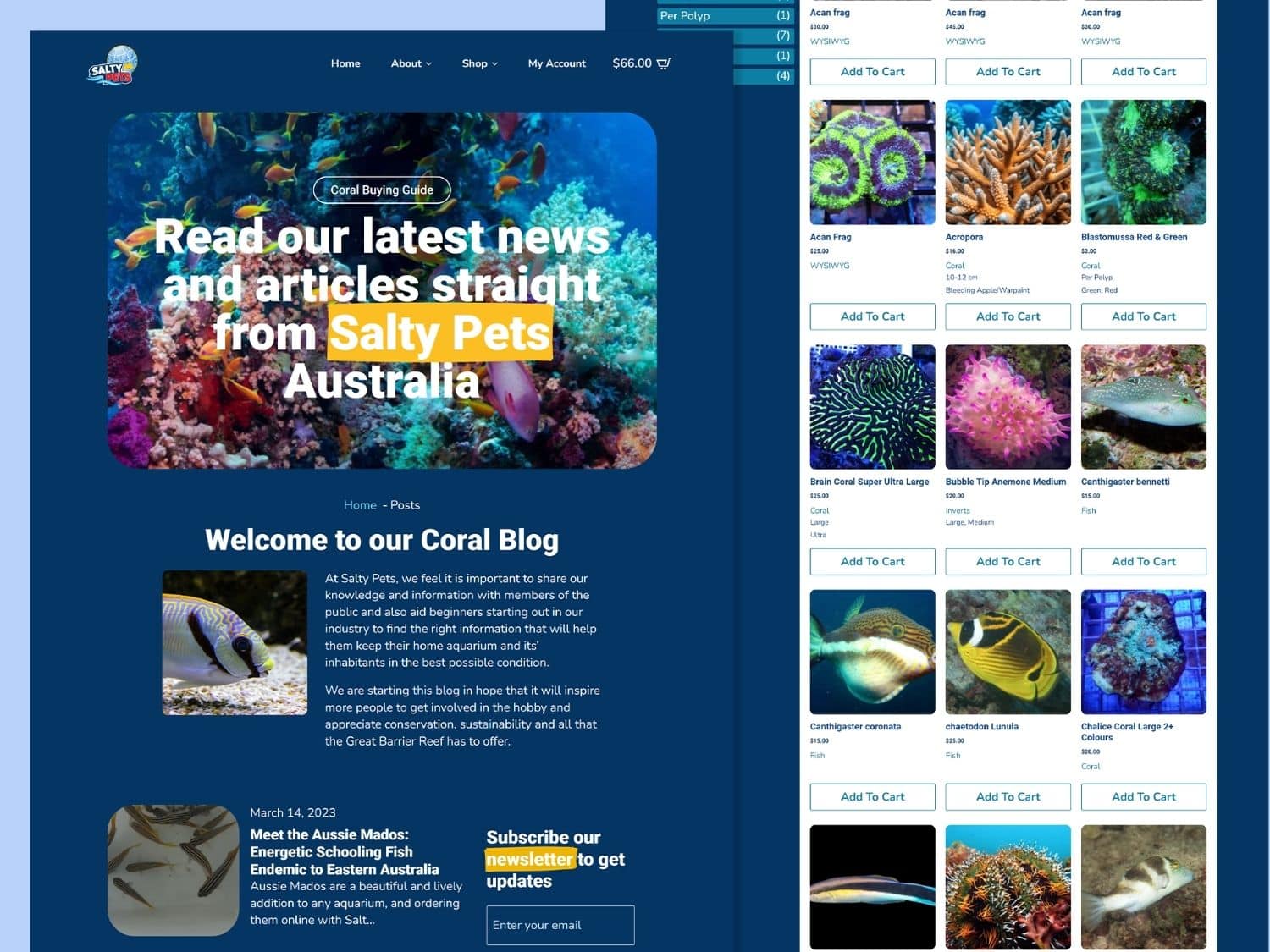
One Storefront Built for Retail and Wholesale Buyers


Salty Pets eCommerce
Summary
Salty Pets needed one WooCommerce store that could support both retail shoppers and approved wholesale buyers. The build created separate shopping experiences, integrated payment and accounting workflows, and added supporting content for trust, usability, and search visibility.
Salty Pets needed more than a standard online store.
The business served two different customer groups: regular retail shoppers and wholesale buyers who needed a faster, more practical ordering experience. That meant the website had to feel simple for casual customers while still supporting a more efficient workflow for approved trade accounts.
When One Store Needs to Serve Two Buying Journeys
A typical eCommerce setup treats every customer the same.
That was the problem.
Retail customers needed a visual, browse-friendly product experience. Wholesale customers needed speed, clarity, and access to pricing or ordering options that weren’t appropriate for the public-facing store.
The site also needed to support payments, accounting, international shipping, tax rules, and stock visibility without creating unnecessary admin work behind the scenes.
Designing Separate Paths Inside One WooCommerce Store
We built a flexible WooCommerce website with two distinct shopping experiences.
Retail customers were given a standard grid-style product layout, making the store easy to browse visually. Approved wholesale customers could use a streamlined list view designed for faster repeat ordering.
Wholesale access was supported by a secure approval process and dynamic pricing options, allowing Salty Pets to manage different customer types without needing two separate websites.
Connecting the Store to the Business Workflow
The build also focused on the operational layer behind the storefront.
PayPal, Stripe, and Xero were integrated to support payment processing and financial workflows. Shipping and tax rules were configured for international orders, helping reduce checkout friction for customers outside the local market.
Inventory behaviour was also refined so out-of-stock products would not be shown unnecessarily, creating a cleaner browsing experience and reducing customer frustration.
Supporting Search, Trust and Customer Questions
Beyond the store itself, the website included supporting content designed to build trust and answer common questions.
A custom FAQ page, clear contact section, and five SEO-focused blog articles gave the site more depth than a basic product catalogue. This helped support search visibility while giving customers more context before purchasing.
Practical Outcomes Beyond Launch Day
| Area | Outcome |
|---|---|
| Retail shopping | Visual product grid for everyday customers |
| Wholesale ordering | Streamlined list view for approved buyers |
| Customer access | Secure wholesale approval workflow |
| Pricing | Dynamic pricing options by customer type |
| Payments | PayPal and Stripe integrated |
| Accounting | Xero connected for financial workflows |
| Shipping | International shipping and tax rules configured |
| Inventory | In-stock display logic to reduce customer friction |
| Content | FAQ, contact page, and SEO blog content added |
Why This Worked
The value of this project came from separating customer needs without separating the business infrastructure.
Retail buyers could browse naturally. Wholesale buyers could order more efficiently. Salty Pets could manage both from one WooCommerce system.
That is the difference between adding eCommerce functionality and designing an eCommerce workflow.
What Made This Different
This wasn’t a large-scale growth campaign or a traditional SEO project. Salty Pets operates within a specialised market where customer access is intentionally selective. The business serves a limited global customer base, with purchasing and distribution requirements shaped by both customer eligibility and regulatory obligations.
Because products were exported internationally, ordering workflows also needed to align with relevant Australian and Queensland requirements, alongside import conditions applying within destination markets.
That changed the role of the website. The goal wasn’t attracting the highest possible volume of traffic or maximising broad product exposure. It was creating a structured system that made purchasing easier for approved customers, supported business processes behind the scenes, and presented information clearly for a highly specific audience.
Sometimes success isn’t measured by reaching more people. It’s measured by making the experience smoother for the right people.
It was a practical eCommerce build with a clear operational purpose: make the store easier to use for different buyers, easier to manage for the business, and better prepared for future visibility.


Want Results Like This?