Want help with this?
Launch Conversion Website SEO
Get a Professional Website designed to start winning new business.
Simple Website Package for new or early-stage service businesses who need to get online properly and start generating enquiries.


Local SEO
This playbook prioritizes visibility over growth, combining owned assets with platform-dependent tactics to dominate local search results and maps.
 Updated 13 October 2026
10 min read
Updated 13 October 2026
10 min read

For new or neglected service businesses, establish a foundation with five sequential steps: optimize your Google Business Profile, fix indexing via Search Console, create dedicated service pages, systematize review requests, and ensure consistent contact details across platforms. I set up local SEO for a new or outdated service business in this order: Google Business Profile, Search Console and indexing, one page per service, a review system, then consistent details and local links. The first three are the foundation and they only work properly together.
When a new service business asks me to help them get found, I don’t start with blog posts, backlinks or a 40-page audit. I start with the same five jobs, in the same order, every time.
This playbook is for you if your business is new, or your website is old enough that nobody has touched it in years. Right now the goal isn’t growth. It’s being visible at all.
Jobs 1 to 3 are the foundation. Jobs 4 and 5 are what keep it working.
For the services I’d call “classic tradie” jobs, especially urgent ones, I start with Google Maps. Someone needs a plumber, checks who’s nearby, reads a few reviews and calls.
Try searching for your service and location. If the Map Pack appears near the top, that’s a prominent place for your business to be visible before someone even reaches the website results.
There’s a difference between that search and researching a bigger project. If my kitchen is flooding, I’m probably Googling “emergency plumber Ballarat” and calling a local business with good reviews. I’m not heading to ChatGPT to write my kitchen sink’s life story and ask for recommendations.
A kitchen renovation is a different decision. There’s time to compare businesses, look through their work and ask more detailed questions. That’s where I’d give the website much more of the heavy lifting.
For a business that needs to get found now, the practical advantage is that I can get its Google Business Profile underway while the website work happens.
What I set up on every profile:
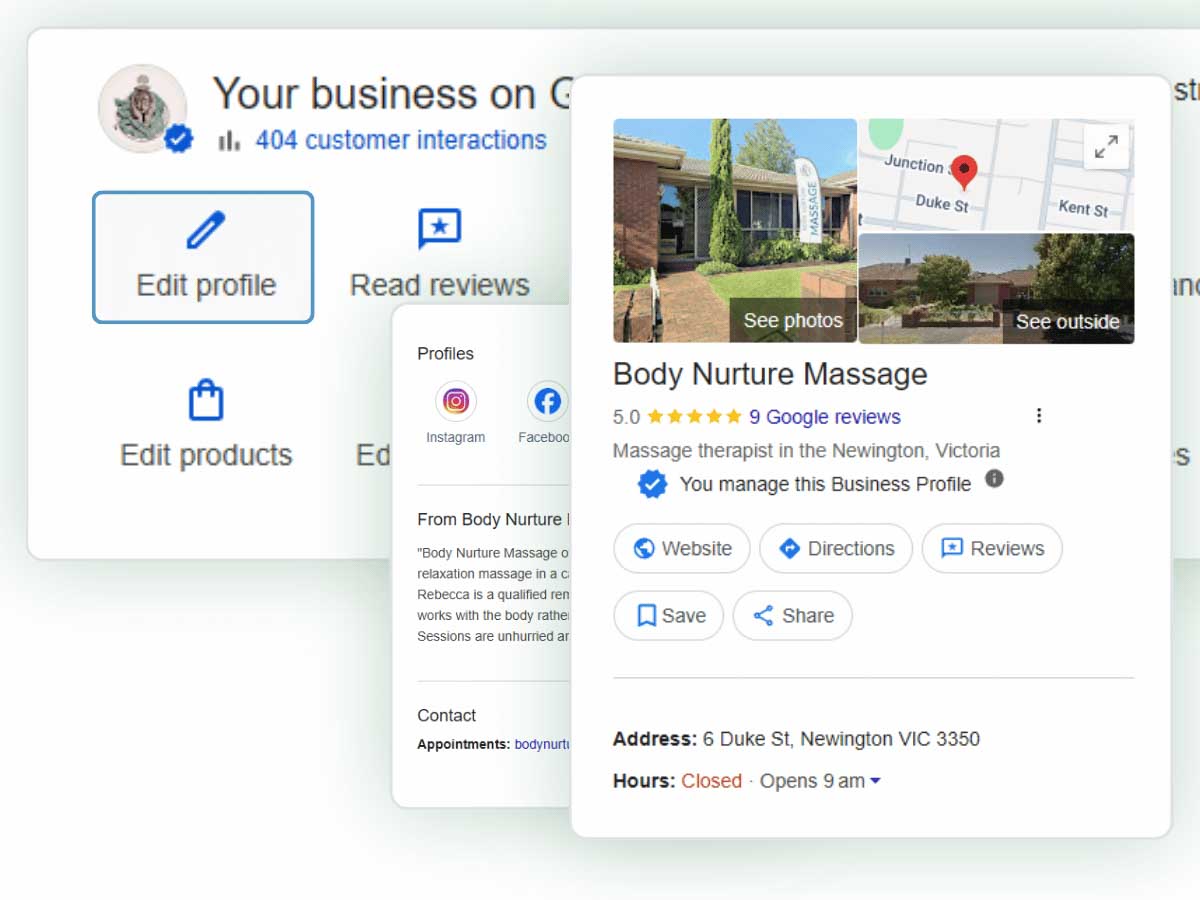
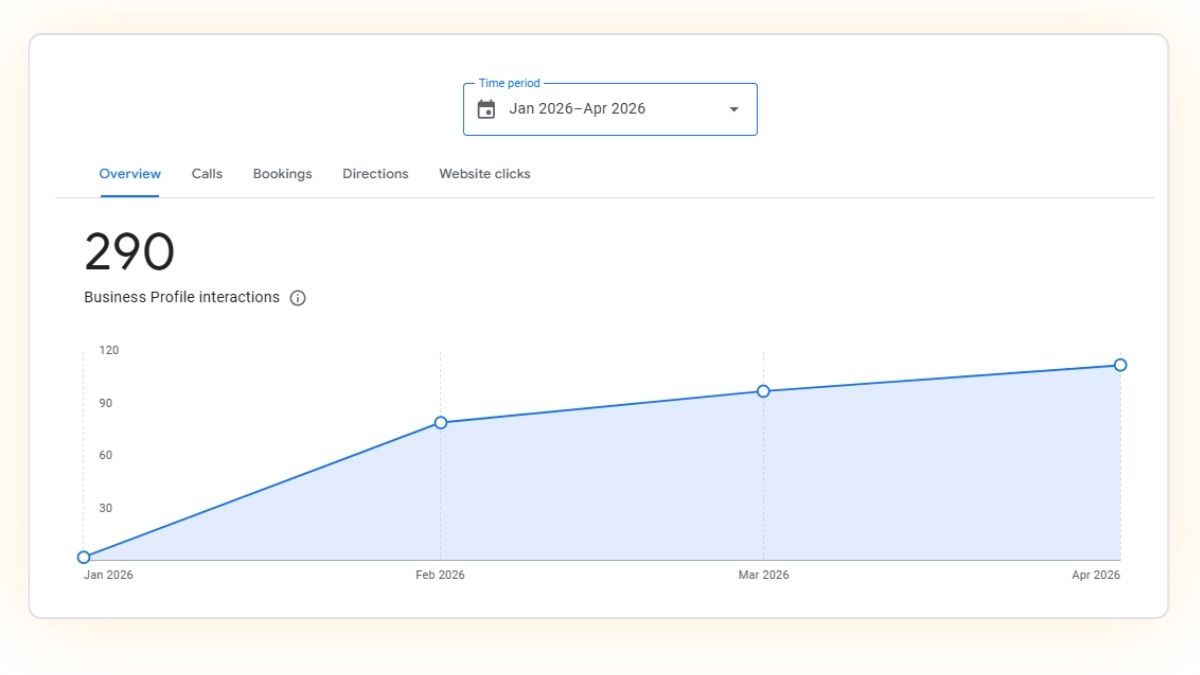
Why this goes first: Body Nurture Massage, a home clinic in Newington, had no profile at all and a one-page Squarespace site that had been sitting untouched for about a year. I set the profile up from scratch alongside a new website. Within weeks it had 290 interactions, including 181 website clicks and 109 direction requests. Direction requests are a strong early sign that someone is planning to visit.
That website link matters more than people expect, too. A Daylesford mobile massage business had its profile pointing at the old http version of its site, so a chunk of visitors hit a “Not Secure” warning before the page loaded. Fixing the link and rewriting the meta lifted click-through from about 2% to 11.12% within 24 hours. Read what I fixed and how here
What I’d prefer you didn’t do: stuff keywords into your business name (“Smith Plumbing Ballarat Emergency Plumber”). It breaks Google’s guidelines and it’s one of the quickest ways to get a profile suspended.
If you want the full walkthrough, my Ballarat Google Business Profile guide goes field by field.
Nothing else on your website counts if Google isn’t indexing it. So before I touch a single heading or meta description, I check what Google can actually see.
What I do:
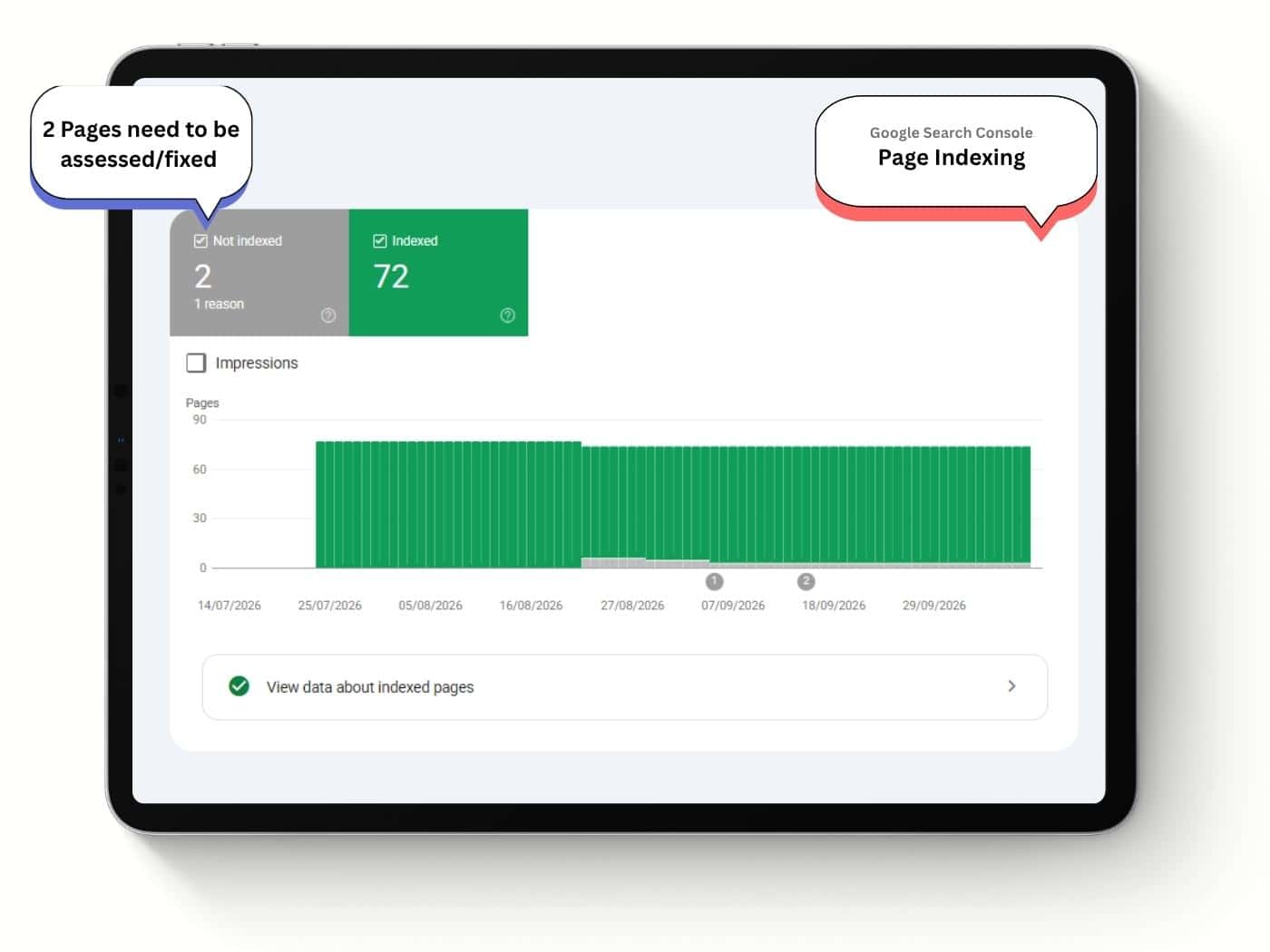
Sunset Bookkeeping gone without a warning: Sunset Bookkeeping in Ballarat had a single-page website ranking at position 6. Between September and November 2025, the homepage quietly dropped out of Google’s index. The site was still live. No outage, no penalty notice, nothing on the surface looked broken. Because it was the only page, the business had effectively disappeared from organic search.
I caught it in Search Console, confirmed the indexing gap and requested reindexing. It was back at position 6 within 48 hours. Read what I fixed and how here
Would they have noticed on their own? Probably not until the phone went quiet.
What I’d prefer you didn’t do: set up Search Console and never open it again. The point isn’t having it connected. It’s having someone look at it.
This is the one I see done backwards most often. Someone hears “fix your meta titles”, rewrites the title on a single Services page, and nothing changes.
That’s because the page has to exist and deserve to rank first. The meta only helps it get clicked.
What I do, in this order:
Why this sits at number 3, not number 1: it’s the biggest job on the list and it depends on the first two. Your profile needs somewhere specific to send people. And there’s no point polishing pages Google can’t index yet.
Sunset Bookkeeping is the cautionary tale here as well. A one-page site has one point of failure. When that page dropped out, there was nothing else holding the business up in search. Separate service pages spread that risk and give Google more than one reason to show you.
What I’d prefer you didn’t do: copy one service page 20 times with a different suburb name swapped in. Thin, near-duplicate pages are one of the indexing problems I end up fixing in job 2.
Reviews are ongoing, so they sit just outside the top three. But in a small market like Ballarat, where people line up three local businesses and compare star counts, they’re one of the biggest Map Pack factors you can influence.
The businesses that get reviews don’t ask harder. They ask every time, automatically.
What I set up:
What I’d prefer you didn’t do: only send the link to clients you’re sure will give five stars. Selectively asking for positive reviews is against Google’s review policy, and a profile full of perfect scores reads as less believable anyway.
This is the off-site work. It goes last for a practical reason: there’s no point listing your business in ten directories until your name, address, phone and service pages are settled. Change your number after that and you’re chasing ten listings.
What I do:
What I’d prefer you didn’t do: pay for a “submitted to 200 directories” package. A handful of accurate, relevant listings beats hundreds of spammy ones you’ll never be able to update.
Here’s the trade-off I explain to every client. Jobs 1 and 4 have the biggest effect on Map Pack results, but they live on Google’s platform. You don’t own them, and the rules change. Jobs 2, 3 and 5 build the thing you do own: a website that’s indexed, has a page for every service and is trusted across the web.
Do the profile on its own and you can possibly land in the Map Pack. If you do but send everyone to a page that can’t convert or isn’t even in Google. Build the website on its own and it can sit for months with nothing pointing at it.


So I don’t sell a “Google Business setup” by itself. I set up jobs 1 to 3 as one foundation, because that’s where the results in this article came from. If you’re doing it yourself, do it in this order. If you’d rather hand it over, that’s what my local SEO setup covers.
Written by
Vanessa Wood
Creator of the ALTC Framework and AI-Ready SEO Strategist at Brighter Websites.
Stay in the loop
Occasional emails from Vanessa about AI search, SEO and website marketing for regional service businesses. No spam, unsubscribe any time.
Or get in touch directlyUh oh, the form hit a snag.
Looks like something didn’t load right.
Give it another go, or flick us a message at support@brighterwebsites.com.au if it keeps failing. We’ll fix it faster than you can say “cache clear.”
You can phone Vanessa too - she doesn't mind a chat 0412401933