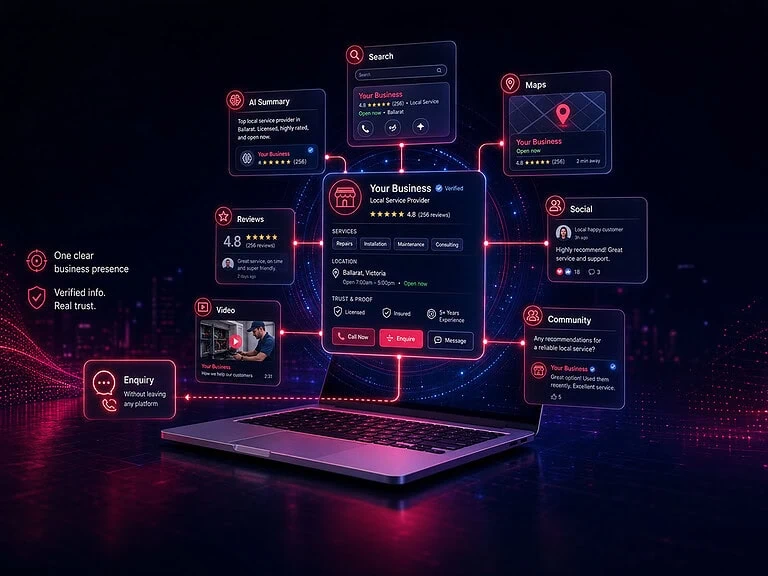
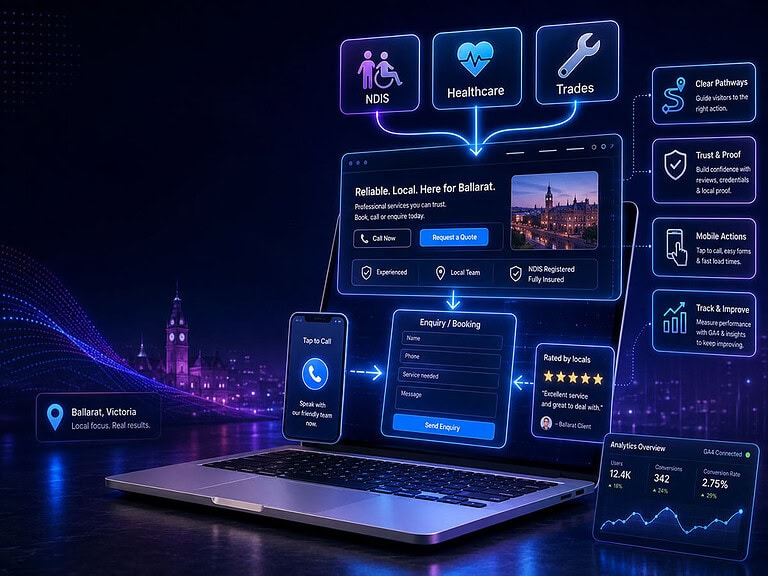
Search Everywhere Optimisation is the process of making your business visible, understandable and trustworthy across every platform people use to research a purchase. Zero-click visibility takes that one step further: giving potential customers enough information and confidence to act without needing to click through to your website first.
Your next customer might find your business without visiting your website. They could see your name in a Google AI Overview. Ask ChatGPT for a local recommendation. Compare reviews in Google Maps. Watch one of your videos. Or read a discussion where someone recommends your service.
Then they call.
That’s the new search journey. And it’s why local businesses need to think beyond rankings and website traffic.
For regional service businesses, this isn’t a reason to abandon SEO.
It’s a reason to build better search infrastructure.
Zero-click search isn’t coming. It’s already here.
For years, SEO followed a reasonably simple path:
- Someone searched Google.
- They clicked a website.
- They read a page.
- They made an enquiry.
That path still exists. It’s just no longer the only one.
SparkToro’s analysis of US Google activity during the first four months of 2026 found that approximately 68% of searches ended without a click. That was up from roughly 60% in 2024.
The data is US-based, so it shouldn’t be treated as an exact Australian benchmark. But the direction is hard to miss.
Search platforms increasingly answer the question before a person reaches a website.
Pew Research found something similar when studying Google searches that included AI-generated summaries. People clicked a traditional result during 8% of visits where an AI summary appeared, compared with 15% when there was no AI summary.
That sounds grim when traffic is your main SEO metric.
It looks different when enquiries are the metric.
A person looking for a local massage therapist may see opening hours, reviews, directions and a booking link in Google Maps. A commercial buyer might ask an AI tool to compare steel fabricators, inspect the suggested companies and call one directly. A homeowner could watch three videos from a local landscaper, search the business name, read the reviews and ring.
No homepage visit.
Still a lead.
The real threat isn’t zero-click search itself. It’s being absent, unclear or unconvincing when the decision happens.
What is Search Everywhere Optimisation?
Search Everywhere Optimisation means building visibility across the places your customers actually search.
That can include:
- Google Search
- Google Maps and your Google Business Profile
- AI Overviews and AI Mode
- ChatGPT, Gemini and Perplexity
- YouTube
- Facebook, Instagram and TikTok
- Reddit and community forums
- Industry directories
- Local media and association websites
- Review platforms
This doesn’t mean your Ballarat accounting firm suddenly needs to dance on TikTok.
Please don’t.
It means understanding where your customers research, what information they need and which platforms influence the final decision. You then make sure those platforms carry consistent facts and credible proof.
Traditional SEO focuses heavily on helping pages rank.
Generative Engine Optimisation, or GEO, helps AI systems understand and cite your information.
Local SEO strengthens your presence in Maps, local results and geographically relevant searches.
Search Everywhere Optimisation joins those disciplines together.
The website remains the source of truth. Your profiles, reviews, videos, directory listings and third-party mentions reinforce that truth. Together, they form a connected authority system rather than a collection of unrelated marketing channels.
Zero-click visibility changes what “winning” looks like
A top ranking is useful.
It’s just not the final outcome.
A business can rank well and still lose the enquiry because the result doesn’t answer the customer’s real questions. It can also receive fewer website visits while generating better leads because more of the early research happened before the person clicked or called.
Zero-click visibility is about what customers can understand without visiting your site.
Can they quickly tell:
- what you do?
- where you work?
- whether you serve people like them?
- what makes you credible?
- whether your service fits their budget?
- how to call, book or request a quote?
- whether your details are current?
That information may appear in Maps, an AI summary, a review excerpt, a social profile or a knowledge panel.
Your job is to make it accurate, consistent and useful.
Not vaguely “optimised”. Useful.
The four layers of Search Everywhere Optimisation
Search Everywhere Optimisation becomes easier to manage when it’s treated as infrastructure rather than a content treadmill.
There are four main layers.
1. Build a technically readable source of truth
Your website gives search engines and AI systems a stable place to verify what your business does.
It should clearly state:
- your business name
- your core services
- the locations you serve
- who each service is for
- your process
- qualifications and experience
- pricing or meaningful cost guidance
- contact and booking options
- policies, guarantees or service boundaries
- evidence from completed work
These facts shouldn’t be buried in clever copy.
A page called “What We Do” that says you “bring ideas to life through personalised experiences” may sound polished, but it tells a machine almost nothing. It doesn’t help a customer much either.
Be specific.
“We provide remedial massage in Ballarat for office workers, active adults and people managing ongoing muscular pain” is easier for people and machines to interpret.
The technical foundation matters too. Important pages need to be crawlable, fast, logically connected and built with clean headings. Business details should remain consistent across the site.
Google says structured data helps it understand the content and entities described on a page. Its LocalBusiness documentation allows businesses to clarify details such as hours, departments and other business information that may be used in Search and Maps displays.
Schema isn’t a magic ranking button.
It’s translation.
And translation becomes more valuable as machines take a larger role in deciding which information to retrieve.
2. Turn business facts into machine-readable information
Structured data should reflect the real business, not invent a better-looking version of it.
Depending on the website, that may include:
- Organisation or LocalBusiness schema
- Service schema
- Person schema for recognised experts
- Article schema
- FAQ schema
- Review or AggregateRating markup where eligible
- Offer information
- areaServed
- openingHours
- sameAs links to verified profiles
- contactPoint information
Google’s guidelines are clear that technically valid markup doesn’t guarantee a rich result. The visible content and structured data must match, and the page still needs to meet Google’s quality requirements.
That matters because schema plugins often create a false sense of security.
A green validation tick only means the code is formatted correctly. It doesn’t mean your services are well explained, your business identity is consistent or your claims can be verified elsewhere.
The stronger approach is to connect your markup to clear on-page facts and third-party evidence.
Your business says it has 20 years of experience.
Where is that demonstrated?
Your page says you serve regional manufacturers.
Do the case studies support it?
You say your process reduces delays.
Can a customer review, project timeline or measured result verify that?
AI systems don’t need louder claims. They need fewer contradictions.
3. Build an authority graph beyond your website
Here’s the thing: a website can say almost anything about itself.
Independent confirmation carries more weight.
Your authority graph is the collection of outside signals that confirms your business exists, operates where it says it does and has genuine experience in the field.
For a regional business, that might include:
- detailed Google reviews
- local Chamber or business-network membership
- industry association profiles
- supplier and partner mentions
- local news coverage
- community sponsorships
- podcast appearances
- project features
- directory listings
- video demonstrations
- customer discussions and recommendations
- social profiles with recent, consistent activity
These signals don’t all have equal value.
A credible industry directory is more useful than 100 rubbish listings generated overnight. A detailed customer review describing the service, suburb and outcome carries more information than “Great job, five stars.”
The aim is consistency.
Your website, Google Business Profile, Facebook page, directory entries and professional profiles should agree on the basics. Business name. Phone number. Service area. Category. Core offer.
When those facts differ, machines need to decide which version to trust.
Sometimes they choose the wrong one.
4. Design for conversion at the citation level
Most businesses optimise a website page and stop there.
Zero-click visibility asks a harder question:
Can the customer act from the information shown outside the website?
Your Google Business Profile should have the right primary category, accurate opening hours, current photos, service descriptions and working call or booking actions.
Your social profiles should explain what you do without forcing people to interpret a collection of inspirational posts.
Your directory listings need a useful description, not a generic tagline.
Your videos should mention your location, service and relevant customer problem in plain language.
And the facts likely to appear in an AI answer should include a sensible next step.
For example:
Brighter Websites designs AI-ready, conversion-focused websites for regional Australian service businesses. Businesses can begin with an AI SEO diagnostic or discuss a new website built around search visibility and offline enquiries.
That sentence works for a person. It also gives a retrieval system a clear description of the business, audience and next action.
That’s citation-level conversion.
Not a hard sell. Just enough useful information for the right person to keep moving.
You don’t need to be everywhere
“Search everywhere” is easy to misread.
It doesn’t mean publishing daily on six platforms.
That’s how business owners end up exhausted, inconsistent and quietly resentful of Canva.
Start with the customer journey.
A regional trade or fabrication company may need:
- a technically strong website
- a complete Google Business Profile
- Google reviews
- project case studies
- industry directories
- YouTube demonstrations
- relevant supplier or association mentions
A local health provider may rely more heavily on:
- Maps
- service-specific website pages
- practitioner credentials
- booking-platform information
- patient-friendly FAQs
- reviews
- local directories
- social proof
A professional services firm could need:
- expert articles
- author profiles
- LinkedIn
- case studies
- association memberships
- media commentary
- strong comparison and pricing pages
Pick the surfaces that already influence your customers.
Get those right first.
How AI systems decide which businesses to mention
No one outside the platforms has a complete formula.
But the broad requirements are becoming clearer.
AI and search systems need to be able to:
- find the information;
- understand what it means;
- connect it to a real business or person;
- check it against other sources;
- decide that it’s relevant to the question;
- present it with enough confidence.
This is why publishing more articles isn’t automatically the answer.
Ten shallow pages can create more noise. One clear service page supported by a strong project story, accurate schema, detailed reviews and credible external mentions may do far more.
Commercial searches are also beginning to change. Semrush reported in July 2026 that AI Overviews across the commercial-intent searches it studied had grown substantially during the previous six months.
The early assumption was that AI summaries would mostly handle simple informational questions.
That boundary is shifting.
People aren’t only asking, “What causes rising damp?”
They’re asking:
- Who fixes rising damp near me?
- Which local provider has experience with heritage homes?
- What should the work cost?
- How do I compare these companies?
- Which one looks safest to call?
That’s decision-stage search.
It’s where proof starts doing the heavy lifting.
What this looks like for a regional business
Regional businesses don’t usually need enterprise-scale content production.
They need clarity, consistency and evidence.
When Brighter Websites rebuilt Guerrilla Steel’s AI-ready search infrastructure, the business reached an 80% AI voice share within 28 days. Brighter’s published project material also connects the broader campaign with measurable revenue growth rather than treating visibility as the final result.
The important part isn’t the number on its own.
It’s what sat behind it:
- clearly defined services
- structured business and offer information
- product-style service detail
- proof from real projects
- consistent authority signals
- content built around actual buyer questions
- conversion paths connected to offline sales
That’s the difference between “doing AI SEO” and building AI-ready infrastructure.
One is a campaign.
The other becomes part of the business.
How to measure zero-click visibility
Website sessions still matter. Rankings still matter.
They’re no longer enough on their own.
A practical Search Everywhere Optimisation dashboard may include:
- Google Business Profile calls
- direction requests
- bookings
- messages
- branded search growth
- map-pack visibility
- review volume and quality
- AI citations or brand mentions
- referral traffic from AI tools
- assisted conversions
- phone enquiries mentioning Google, ChatGPT or another platform
- enquiry quality
- quote requests
- sales outcomes
Ask one extra question during your sales process:
“Where did you first hear about us?”
Then ask:
“What made you contact us?”
Those two answers often reveal a messier journey than analytics can show.
Someone may first encounter your business in an AI answer, watch a video, read your reviews, visit the site two days later and call from the Google profile.
Last-click analytics will tell a small part of that story.
The customer will tell you the rest.
A seven-question Search Everywhere visibility audit
Try these checks before investing in more content.
1. Can AI accurately explain what your business does?
Ask several AI tools:
What does [business name] do, who do they serve and where are they based?
Look for missing, vague or incorrect details.
2. Do you appear in local recommendation searches?
Test realistic questions such as:
Which companies provide [service] in [region]?
Don’t only test your business name. Customers who already know your name aren’t the visibility problem.
3. Does your Google Business Profile answer the obvious questions?
Check categories, services, photos, hours, service areas, phone numbers, booking links and review recency.
4. Can someone find useful pricing guidance quickly?
You don’t always need fixed prices. A starting range, cost factors or example projects can remove uncertainty.
“Contact us for a quote” isn’t pricing information.
5. Can your strongest claims be verified?
Qualifications, years of experience, project outcomes, memberships and specialties should be supported somewhere credible.
6. Are your business details consistent across major platforms?
Search your name, phone number, address and core services. Fix outdated profiles before creating new ones.
7. Is there a clear action available without visiting the homepage?
A potential customer should be able to call, book, request a quote or find directions from your primary search surfaces.
A “yes” to all seven is uncommon.
That’s good news. It means there’s usually plenty of room to improve without publishing 50 new articles.
Do local businesses still need a website?
Absolutely.
But its role is changing.
Your website is no longer just the destination at the end of a Google click. It’s the source that other systems use to understand and verify the business.
It gives you control over:
- service explanations
- proof and case studies
- your positioning
- detailed pricing guidance
- qualifications
- location information
- structured data
- conversion paths
- content that answers complex questions
- the facts AI tools may retrieve
Social profiles come and go. Directories change their rules. Search features are redesigned.
Your website is the infrastructure you own.
A good one supports visibility everywhere else.
Search Everywhere Optimisation starts with clarity
The search journey has fragmented.
Your business presence shouldn’t.
You don’t need to chase every new platform or rename your marketing strategy each time an acronym appears. You need a clear business identity, technically sound website, accurate structured information, credible proof and practical ways for customers to act.
That foundation supports traditional SEO.
It supports local search.
It supports AI visibility.
And it supports the part that actually matters: more of the right people finding enough evidence to contact your business.
Even when there’s no click.
Need to know where your visibility is breaking?
An AI SEO Deep Dive can stress-test how your business appears across Google Search, Maps, AI Overviews and conversational search tools.
The goal isn’t another generic SEO report.
It’s to identify where your information is missing, where platforms receive conflicting signals and what needs to change so customers—and the systems guiding them—can understand why your business belongs on the shortlist.
And when the existing website was built for an earlier version of search, patching individual pages may not be enough. A Future-Proof Growth Website rebuilds the foundation around clear offers, regional authority, machine-readable proof and conversion paths connected to real enquiries.
Frequently asked questions
What is zero-click search?
Zero-click search happens when a person gets the information or takes the next step without clicking a traditional website result. They may read an AI summary, call from Google Maps, view opening hours, request directions or use a booking action directly from the search results.
What is Search Everywhere Optimisation?
Search Everywhere Optimisation is the process of improving how a business is discovered and understood across search engines, maps, AI tools, social platforms, video sites, review platforms and relevant third-party websites. It combines technical SEO, local visibility, structured information, authority building and conversion planning.
What is the difference between SEO and GEO?
SEO primarily improves visibility in traditional search engines. GEO, or Generative Engine Optimisation, helps AI and answer engines understand, retrieve and cite information. They overlap heavily. A technically weak website with unclear services won’t perform well in either environment.
How can a local business appear in ChatGPT or AI Overviews?
Start by making the business easy to verify. Publish clear service and location information, add appropriate structured data, build detailed case studies, maintain accurate profiles, earn genuine reviews and develop credible third-party mentions. No single tactic guarantees inclusion.
Do I still need a website when searches don’t generate clicks?
Yes. Your website acts as the primary source of truth for your services, experience, proof, locations and offers. Search engines, AI tools and customers may use it to verify information even when it isn’t the final conversion point.
Does schema guarantee better AI visibility?
No. Schema can help machines interpret your information, but it won’t compensate for weak content, contradictory business details or unsupported claims. It’s one part of a wider authority and visibility system.