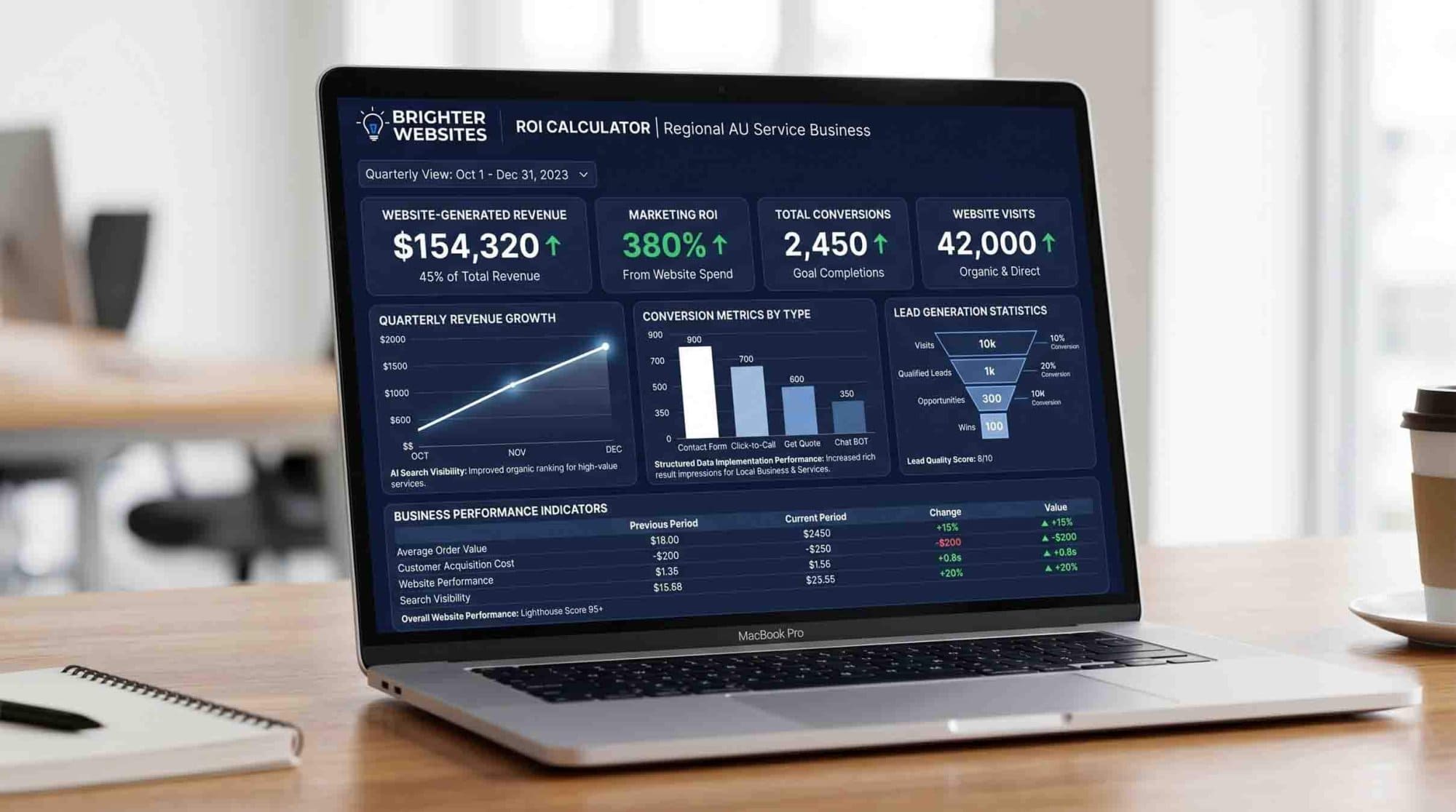
A website should be judged by what it returns. This Website ROI Calculator helps businesses estimate the revenue opportunity hidden in their current website by comparing their existing performance against realistic growth targets. While the calculator provides a useful starting point, real growth depends on factors like market demand, competition, search visibility, authority, trust signals, and conversion performance.
If your website isn't generating enough enquiries, leads, or revenue, the issue may not be traffic alone. It could be authority, conversion pathways, structured data, or AI visibility. Understanding the gap is the first step. Building the systems to close it is where the real opportunity lies.
Table Of Contents
“How much does a website cost?” It’s understandable. Building or upgrading a website is an investment, and naturally you want to know what that investment will be. But after working with service businesses across Regional Australia, I found that question often points people in the wrong direction.
The real question isn’t what a website costs. It’s whether investing in a high-performing website will generate a worthwhile return for your business.
Every month your website either helps generate enquiries, build trust, and convert visitors into clients, or it doesn’t. The difference between those outcomes can be worth tens or even hundreds of thousands of dollars each year.
Before worrying about website pricing, it’s worth understanding the revenue opportunity available in your market and what it may take to capture it.
Calculate Your Website Revenue Opportunity
Use the calculator below to estimate the revenue gap between your current sales and where you want your business to be.
Free Calculator
Lead & Revenue Gap Calculator
Find out exactly how many more leads you need to hit your goal — and what that gap costs you every year.
$
$
▲
Fill in your numbers to see your gap
Your close rate——
Current monthly revenue—
Extra leads needed——
Solving your lead gap is worth$0per year in additional revenue
✓
You're already hitting that goal
Know your gap. Now let's close it. We build the systems that turn more leads into paying clients.
The calculator isn’t designed to provide an exact financial forecast. What it does provide is perspective. It helps us towards identifying the size of the opportunity available to you. And whether pursuing that growth could justify investing in a stronger website and digital growth strategy.
However, the calculator is only the starting point. To determine whether those revenue goals are realistically achievable, we need to assess:
The level of organic demand for your services
The size of the opportunity in your market
The strength of your competitors
Your current visibility and authority
The conversion performance of your website
Only after understanding these factors can we map a realistic roadmap for growth and determine what it will take to win in your market.
Why Website Cost Is Often The Wrong Metric
Imagine two businesses.
Business A spends $3,000 on a website.
Business B invests $7,000.
At first glance, Business A appears to have made the smarter financial decision. But what if Business B generates an additional $120,000 in revenue every year because its website converts visitors more effectively?
Suddenly the cheaper website becomes the more expensive decision.
The value of a website isn’t determined by its build cost. It’s determined by its ability to generate business outcomes – like more revenue. More enquiries.
Better Visibility, Increases Authority and reach, Brand Awareness and then Improve Sales and the bottom line.
How Website Revenue Is Calculated
At its simplest, website performance follows a predictable formula.
Website Revenue = Visitors × Conversion Rate × Close Rate × Average Client Value
Every website has these four moving parts. Increase any one of them and revenue improves. Increase several at once and growth compounds surprisingly quickly. For example:
500 monthly visitors
3% enquiry conversion rate
30% sales conversion rate
$5,000 average project value
Produces approximately: $270,000 in annual revenue.
Improve the conversion rate from 3% to 5% with no other changes.
Now the same traffic produces $450,000 in annual revenue.
That’s a $180,000 difference from a relatively small performance improvement.
The website didn’t need more traffic – It needed better “conversion infrastructure”.
Understanding What’s Actually Achievable
One of the biggest mistakes businesses make is assuming that every revenue target is achievable simply by launching a new website.
That’s rarely the case.
A website is only one part of the equation. Before making recommendations, we assess the market itself.
How many people are searching for your services?
How competitive is your industry?
Who currently dominates the search results?
How strong are their websites, content, authority, and trust signals?
These answers help me to determine the true opportunity available and what level of investment is required to compete effectively. Only after completing this analysis can we (me and you) realistically determine whether stronger visibility, better conversion pathways, and improved trust signals will deliver the growth you’re aiming for.
Where Most Website Revenue Gaps Come From
The majority of businesses in Ballarat don’t have a traffic problem. I can see that from browsing sites in many different markets here locally… They usually have a conversion problem or an authority problem and often both.
What are Weak Conversion Paths
This is when visitors arrive. They browse then leave because the next step isn’t obvious or has too much friction. Every unnecessary click, confusing page, or unclear call-to-action creates friction that kills enquiries.
Poor Trust Signals
Most service businesses underestimate how much trust influences buying decisions. People want evidence. Proof. They want confidence that they’re making the right choice.
In regional markets like Ballarat, businesses have traditionally relied heavily on word of mouth and referrals to build trust and win new clients. But in the AI era, the way people validate recommendations is changing. A referral is often no longer the final step in the buying journey.
Potential customers are increasingly turning to Google, AI assistants, and search platforms to get a second opinion before making a decision. They’re asking questions about your experience, expertise, reputation, and credibility.
And AI systems can only work with the information available to them.
That means businesses need to actively build the narrative around their expertise through their website, authority content, reviews, case studies, credentials, and the signals they generate across the web through brand mentions and customer feedback.
Without clear evidence of expertise and trustworthiness, both potential customers and AI systems may struggle to confidently recommend your business. Many potential clients simply move on. Without case studies, authority content, reviews, credentials, and demonstrated expertise, many potential clients simply move on.
Invisible Expertise
Many businesses know their industry inside out. Their website just doesn’t communicate it to visitors or to Google. Or increasingly, to AI search systems.
Your expertise might be real. But if search engines and AI platforms can’t understand it, they can’t recommend it. And that’s often when business owners start wondering why competitors with less experience, weaker workmanship, or a poorer reputation seem to be getting all the visibility.
Why is the local operator you wouldn’t personally recommend showing up ahead of you?
Why are larger Melbourne-based companies appearing in search results and AI recommendations for jobs in your area?
The answer is rarely that they’re better. It’s usually that they’ve done a better job of communicating their expertise online. Search engines and AI systems can’t judge what they can’t see. If your knowledge, experience, qualifications, projects, and customer outcomes aren’t clearly demonstrated on your website, those systems have very little evidence to work with.
The businesses that get recommended are often the businesses that have made their expertise visible, understandable, and easy to trust.
Missing Structured Data
Search engines don’t read websites the way humans do. They rely heavily on structured information. Without clear entity relationships, schema implementation, service definitions, and contextual signals, much of your expertise remains hidden.
Reduced visibility and missed opportunities. And updating your website to be machine readable is just the beginning! Check out how we are preparing our client’s websites for the new WebMCP standard so prospects can perform tasks like completing enquiry forms in an automated agent mode.
The Difference Between A Website And Revenue Infrastructure
The goal should be building a business asset, not just launching a website. A website is not simply a collection of pages. It’s part of a larger growth system. That system includes:
When these components work together, the website becomes revenue infrastructure. That’s when real ROI starts appearing.
What AI Search Is Changing
Search is evolving. Increasingly, AI systems evaluate businesses based on expertise, authority, credibility, and evidence rather than simply matching keywords. This changes how websites need to be built.
Businesses that invest in structured data, authority content, and clear topical expertise are creating assets that are more likely to be surfaced in AI-powered search experiences. Those that don’t risk becoming harder to find, regardless of how attractive their website looks.
A modern website must perform for both people and machines. The technical foundations matter more than ever.
How We Help Businesses Close The Revenue Gap
When businesses discover a significant opportunity gap through the calculator, the next step is research and diagnosis. What’s preventing the website from performing?
Sometimes it’s visibility.
Sometimes it’s conversion.
Sometimes it’s authority.
Often it’s a combination of all three.
I begin by assessing the market opportunity, the level of organic demand, and the competitive search visibility landscape. From there, we create a roadmap that outlines what it will take to achieve your goals and whether the opportunity justifies the investment. My approach focuses on building the underlying infrastructure required for sustainable growth.
Each element contributes to reducing the revenue gap identified by the calculator.
Future-Proof Growth Websites
Websites designed around business outcomes rather than aesthetics alone.
Helping search engines and AI systems understand, trust, and recommend your business.
Structured Data Implementation
Providing the machine-readable context modern search systems increasingly depend on.
Conversion Optimisation
Improving the percentage of visitors who become enquiries and clients.
What Is Your Website Actually Worth?
The answer isn’t found in a website quote. It’s found in the difference between where your business is today and where it could realistically be with the right strategy, market opportunity, and execution.
That’s why we recommend starting with the calculator. It helps quantify your goals against the opportunities. Only then can you make an informed decision about whether investing in a high-performing website is worthwhile.
Use the calculator above to estimate your revenue opportunity.
Then, if you’d like help understanding what’s possible in your market, book a Website Revenue Audit and we’ll show you exactly where the biggest growth opportunities exist.
Subscribe to our blog or get in touch.
Get in touch with with Vanessa. Your Ballarat website strategist, designer and developer.
Occasional emails from Vanessa at Brighter Websites about AI, SEO, Website Marketing for regional service businesses.
See what we have done
More Articles
Discover more expert insights to the latest Web Design and SEO trends, these curated blog posts are designed to broaden your horizons and spark your imagination.